Chapter 1 - States of Matter and Phase Changes
Comprehensive Questions & Answers for Class 9 Chemistry (Punjab Board)
Need to Divide Chemistry into Branches
1- To understand the vast and complex subject of Chemistry, it is divided into many branches.
2- To concentrate on its specific aspects
3- For deeper understanding and address various scientific problems.
Physical Chemistry and Nuclear Chemistry
- Physical chemistry covers reactions involving electrons outside the nucleus.
- Nuclear chemistry covers reactions involving electrons inside the nucleus.
Problems Solved in Analytical Chemistry
1- Analysis of substances.
2- Identifying components.
3- Detecting impurities.
4- Measuring quantity of substance.
Difference Between Graphite and Graphene
The structure of graphite is multilayered while graphene is single layered.
Importance of Supercritical Fluids
Supercritical Fluid:-
The fluid which shows properties of both liquid and gas is called supercritical fluid.
Importance:-
1- They can dissolve substance like a liquid and diffuse like gas.
2- It is important in various industry as extraction, cleaning and solvent.
State of Matter in the Sun
Matter in Sun primarily exists in the Plasma state.
Importance of Graphene
Graphene is important because it is tough, flexible and light weight with high resistance.
It has wide range of applications in electronics and medical devices.
Most Common Form of Matter
Most material things in the world belongs to the solid state of matter such as furniture, building etc.
Supercritical State
A supercritical state looks like a cloudy fluid that behaves both like a gas and a liquid, often appearing foggy in a container.
Formation of Plasma
Plasma is created in a fluorescent tube when electricity is passed through the gas, causing the gas atoms to ionize and form a mixture of positively charged ions and free electrons, which emits light.
Organic Chemistry and Biochemistry
Organic chemistry deals with the carbon-based compounds while biochemistry deals with the study of chemical processes in living organisms.
Brilliance of Diamond
The brilliance of diamond is due to its reflection and refraction of light.
Improving brilliance:
The brilliance can be improved by cutting diamond that maximizes light reflection.
Dissolution of Sodium Chloride
Solubility of Different Compounds
Here solubility rule “Like dissolves like” applied. As water is polar solvent, so ionic and polar compounds are more soluble in water due to strong solute-solvent interaction while non-polar compounds are less soluble in water.
Crystallization of NaCl and KNO₃
NaCl reaches its solubility limit more quickly and does not form crystals in the same way as KNO₃ when cooled.
Slippery Nature of Graphite
Branches of Chemistry
(a) Rate of a reaction: Physical chemistry
(b) Digestion of food in human body: Biochemistry
(c) Properties of plasma: Physical chemistry
(d) Ecosystem: Environmental chemistry
(e) Reactions taking place during fireworks: Inorganic chemistry
(f) Measurements of absorption of wavelength with the help of ultraviolet spectrometer: Physical chemistry
Allotropy of Carbon and Sulphur
Supercritical Fluids
Supercritical Fluids:
Supercritical fluids are highly compressed states which shows both properties of gases and liquids.
Example:
Supercritical carbon dioxide.
Differ from ordinary liquids:
Chemical reactions which may not be carried out in conventional solvents, may possibly be carried out in supercritical carbon dioxide. Supercritical fluids are different from ordinary liquids because these fluids exhibit properties of both liquid and gases and used in specialized chemical reactions.
Solubility and Effect of Temperature
Solubility:
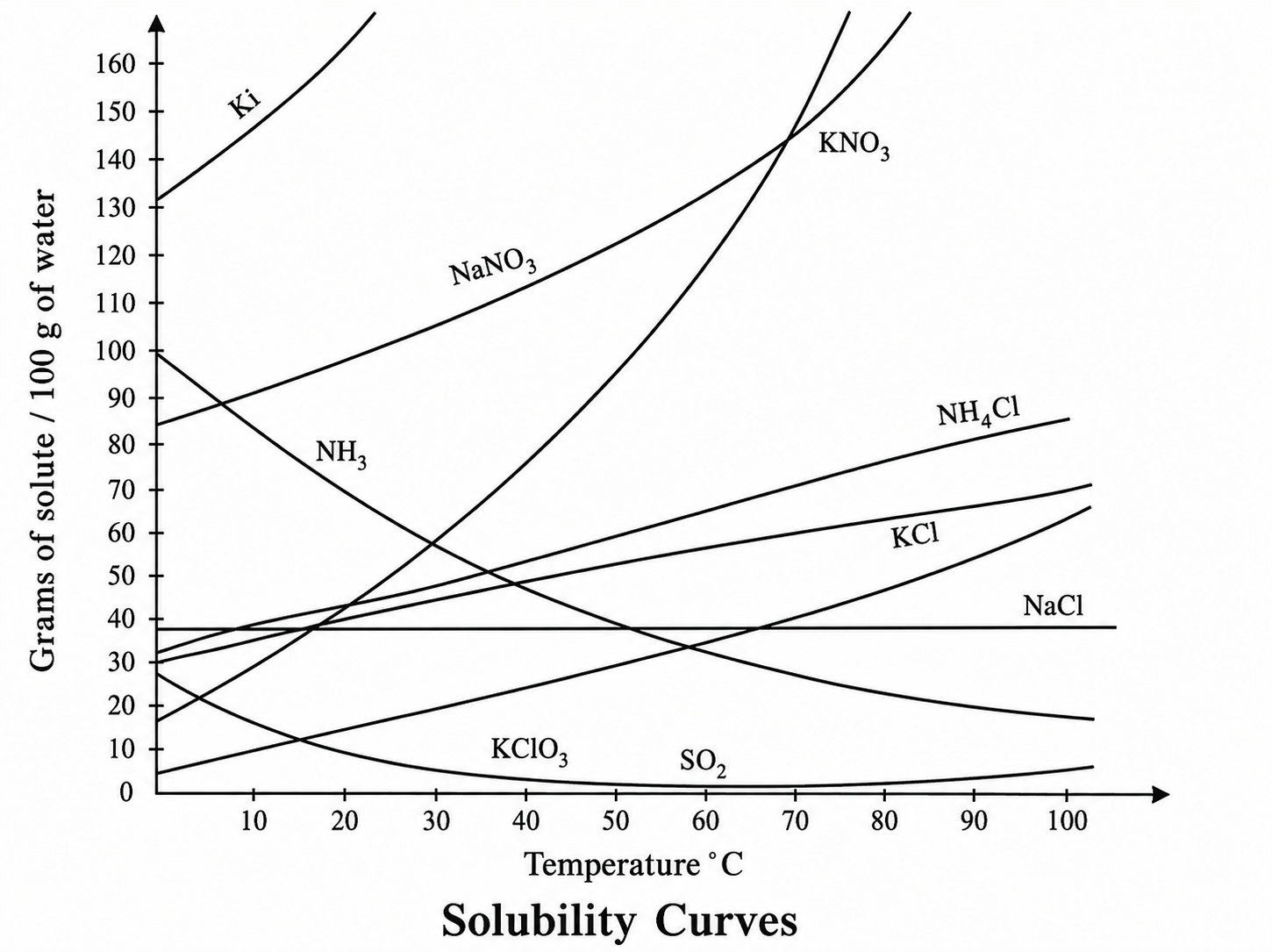
The solubility of a solute is the amount of a solute which can dissolve in 100g of a solvent at particular temperature.
Effect of temperature on solubility of solutes:
Change in temperature has different effects on the solubility of different compounds. Usually the solubility increases with increase in temperature but it cannot be taken as general state rule. There are large numbers of compounds whose solubility in water increases with the increase in temperature e.g. potassium nitrate (KNO₃), silver nitrate (AgNO₃) and potassium chloride (KCl) etc.
The solubility of sodium chloride in water does not increase appreciably with the increase in temperature. The solubility of compounds like lithium carbonate (Li₂CO₃) and calcium chromate (CaCrO₄) decreases with increase in temperature. The solubility of gases also decreases with increase in temperature.
Movement of Gaseous and Liquid Molecules
Movement present in gaseous molecules:
In gases, molecules are very widely apart with no order and very weak intermolecular forces. Gaseous molecules show translational, rotational and vibratory motion.
Movement present in liquid molecules:
In liquids, molecules are closely attached but moving randomly. They are not easily compressible. There exists significant intermolecular forces.
Inorganic and Organic chemistry
Inorganic chemistry:
It is the study of synthesis, composition, properties and structure of elements and compounds that contain little or no carbon. An inorganic substance can be composed of metals, non-metals or a mixture of these Salts, catalysts, pigments, coating and much more.
Organic Chemistry:
It is the branch of chemistry that deals with carbon compounds (hydrocarbons and their derivatives) other than its simple salts like carbonates, bicarbonates, oxides and carbides.
In this branch, we study the structure, formation, properties, composition and reactions of carbon-containing compounds.
Organic compounds are found in all forms of life and are also essential for life.
Crystallization / Purification of Potassium Nitrate
To purify potassium nitrate (KNO₃) through crystallization:
- Dissolve impure potassium nitrate in hot water to make a saturated solution.
- Filter the solution to remove any insoluble impurities.
- Cool the solution slowly. As it cools, potassium nitrate will crystallize.
- Filter out the crystals and separate them from the remaining solution (mother liquor).
- Dry the crystals by allowing them to air-dry or by using a drying oven.
This process removes impurities and yields purified potassium nitrate crystals.
Properties of Graphene in Electronics
Graphene is highly useful in electronics due to its exceptional electrical conductivity, strength, flexibility, and lightweight nature. These properties make it a promising material for next-generation electronics, such as transistors, sensors, and flexible displays.