Chapter 3 - Chemical Bonding
Comprehensive Questions & Answers for Class 9 Chemistry (Punjab Board)
Elements that Lose & Gain Electrons Easily
1) Elements that lose electrons easily:
Metals generally have a tendency to lose electrons easily and therefore are called electropositive elements.
Examples:
i. Alkali metals (Na, K)
ii. Alkaline earth metals (Mg, Ca) etc.
2) Elements that gain electrons easily:
Non-metals generally tend to gain electrons easily and therefore are known as electronegative elements.
Examples:
i. Halogens (F, Cl, Br, I)
ii. Oxygen, Nitrogen, Sulphur, Phosphorus etc.
Existence of lower molecular mass covalent compounds as gases
Lower molecular mass covalent compounds exist as gases or low boiling liquids.
1) Reason:
Because they have weak intermolecular forces of attraction, requiring less energy to break their bonds, due to which their densities and boiling points are very low.
2) Example:
i. Diatomic molecules e.g. N₂, O₂, F₂, Cl₂ and many binary covalent compounds e.g. CH₄, NH₃, etc exist as gases at room temperature.
ii. Some covalent compounds like bromine (Br₂) exist as volatile liquids.
Crystalline Solid with Covalent Bonding
Crystalline solid having covalent bonding:
Diamond is a crystalline solid in which each carbon atom is surrounded by four other carbon atoms linked together by strong covalent bonds.
Property of Metal (Malleability & Ductility)
Metals can be easily shaped and stretched into wires (malleability) or sheets (ductility).
Reason:
Because in metals, the layers of atoms can slide over each other without breaking the metallic bond. This ability is a result of presence of sea of electrons and hence the free movement of electrons helps to maintain the bond even when the metal is deformed.
Coordinate Covalent Bond
Yes, a coordinate covalent bond is generally considered to be as strong as a regular covalent bond, meaning it is considered a strong bond, however, depending on the specific atoms involved, it can sometimes be slightly weaker due to its polar nature and the fact that one atom is bonding the entire electron pair to the bond.
Dot and Cross Formula of HNO₃
i) Dot and cross formula of HNO₃:
Here is the dot and cross representation of nitric acid (HNO₃):
i. Central atom: Nitrogen (N)
ii. Double bond between N and one oxygen (O),
with two lone-pairs on oxygen.
iii. Single bonds between N and other two oxygen
atoms.
a) One oxygen has an H-atom attached (O-H).
b) The oxygen in the single bond carries a negative charge, balanced by positive charge on -N.
Dot and cross structure of HNO₃.
HF is a liquid & HCl is a gas (Reason)
1) HF is a liquid.
Reason:
Hydrogen fluoride is a liquid at room temperature because of strong intermolecular hydrogen bonding present in it.
2) HCl is a gas.
Reason:
Hydrogen chloride (HCl) is a gas at room temperature because the molecules have weak intermolecular dipole-dipole forces, primarily due to lack of significant hydrogen bonding, allowing them to easily move around and not condense into liquid phase at normal temperatures.
Covalent compounds are not soluble in water (Reason)
Covalent compounds are generally not soluble in water.
Reason:
Because covalent compounds are usually non-polar and cannot interact effectively with polar water molecules.
Conduction of Heat through Metals
Conduction of heat through metals:
Metals conduct heat through the free movement of delocalized electrons and lattice vibrations i.e, when heat is supplied, the free electrons absorb and transfer the thermal energy quickly throughout the metals.
Oxides of Nitrogen
Oxides of nitrogen:
Nitrogen forms five different oxides.
| Names | Formulae |
| Nitric oxide | NO |
| Nitrogen dioxide | NO₂ |
| Nitrous oxide | N₂O |
| Dinitrogen trioxide | N₂O₃ |
| Dinitrogen pentoxide | N₂O₅ |
Reaction of NaBr with AgNO₃ in water
1) Reaction of NaBr with AgNO₃ in water:
When sodium bromide (NaBr) reacts with silver nitrate (AgNO₃) in water, a pale yellow precipitate of silver bromide (AgBr) forms, while sodium nitrate (NaNO₃) remains dissolved in the solution.
2) Chemical equation:
NaBr+AgNO₃ ---water------> AgBr ↓+NaNO₃ (pale yellow ppt.)
Existence of Iodine as a Solid and Cl₂ as a Gas
1) Existence of iodine as a solid and Cl₂ as a gas:
Reason:
Both iodine (I₂) and chlorine (Cl₂) experience the same type of intermolecular force, which is London dispersion forces/vander Waals forces only, as both are non-polar molecules.
However, iodine has stronger London dispersion forces due to its larger electronic cloud i.e, larger molecular size than chlorine, resulting in existence as a solid.
Ionic & Covalent Bond
1) Ionic Bond
i- Definition:
"The type of chemical bond, which is formed due to complete transfer of electron from one atom to another atom, is called ionic bond."
ii. Formation:
The ionic bond is formed as a result of tendency of atoms to lose or gain electron or electrons to acquire the electronic configuration of the nearest noble gas, because this is a more stable electronic structure.
iii. Example of Sodium Chloride (NaCl):
a. This ionic compound is formed when the elements sodium and chlorine react chemically. The electronic configuration of these elements are as follows:-
| Elements | First shell | Second shell | Third shell |
| ₁₁Na | 2 | 8 | 1 |
| ₁₇Cl | 2 | 8 | 7 |
Electronic configuration of Sodium and Chlorine:
b- When sodium(Na) reacts with chlorine(Cl), sodium loses one electron from its outermost shell and chlorine gains that electron. This results in formation of sodium ion(Na+) and a chloride ion(Cl-), each achieving the electronic configuration of nearest noble gas (Ne for sodium and Ar for chlorine).
Na → Na+ + e-
e- + Cl → Cl-
Na + Cl → Na+Cl-
c- The positively charged sodium ions(Na+) and negatively charged chloride ions(Cl-) are held together by electrostatic forces, forming an ionic bond and creating sodium chloride(NaCl), an ionic compound.
iv- Examples of ionic compounds:-
a. Potassium chloride(KCl).
b. Magnesium fluoride(MgF2).
c. Sodium fluoride(NaF).
d. Potassium bromide(KBr).
e. Calcium fluoride(CaF2).
2) COVALENT BOND
i. Definition:-
"Covalent bond is defined as the force of attraction that arises between two atoms due to mutual sharing of their electron pairs.
ii) Formation:-
a. Approaching of atoms/Changes in energy:-
When two atoms approach each other, in order to form a bond, they undergo important changes in their energy.
i. Lowering of energy:-
The electrons belonging to one atom will come under the attractive influence of the nucleus of the other atom. This is the new force of attraction and will be responsible for lowering the energy.
ii. Increase of energy:-
The electrons and the nucleus of one atom will also repel the electrons and the nucleus of other atom. This is the force of repulsion and will obviously increase the energy.
b. Domination of attractive forces:-
The two atoms will bring themselves at such a distance so that the attractive forces dominate the repulsive forces. The total energy at this distance will be minimum and thus a stable molecule is formed.
iii) Example of Water(H2O):-
A water molecule is formed when two hydrogen atoms share their electrons separately with the electrons of one oxygen atom. After sharing, both hydrogen and oxygen achieve the electronic configuration of nearest noble gases.
:Ö: xH
xH
:Ö:-H
-H
.: Dot and cross structure of H2O
iv) Examples of covalent compounds:-
a- Carbon dioxide(CO2).
b- Hydrogen cyanide(HCN)
c- Ammonia(NH3).
d- Methane(CH4).
e- Ethene(C2H4).
f- Methanol(CH3OH).
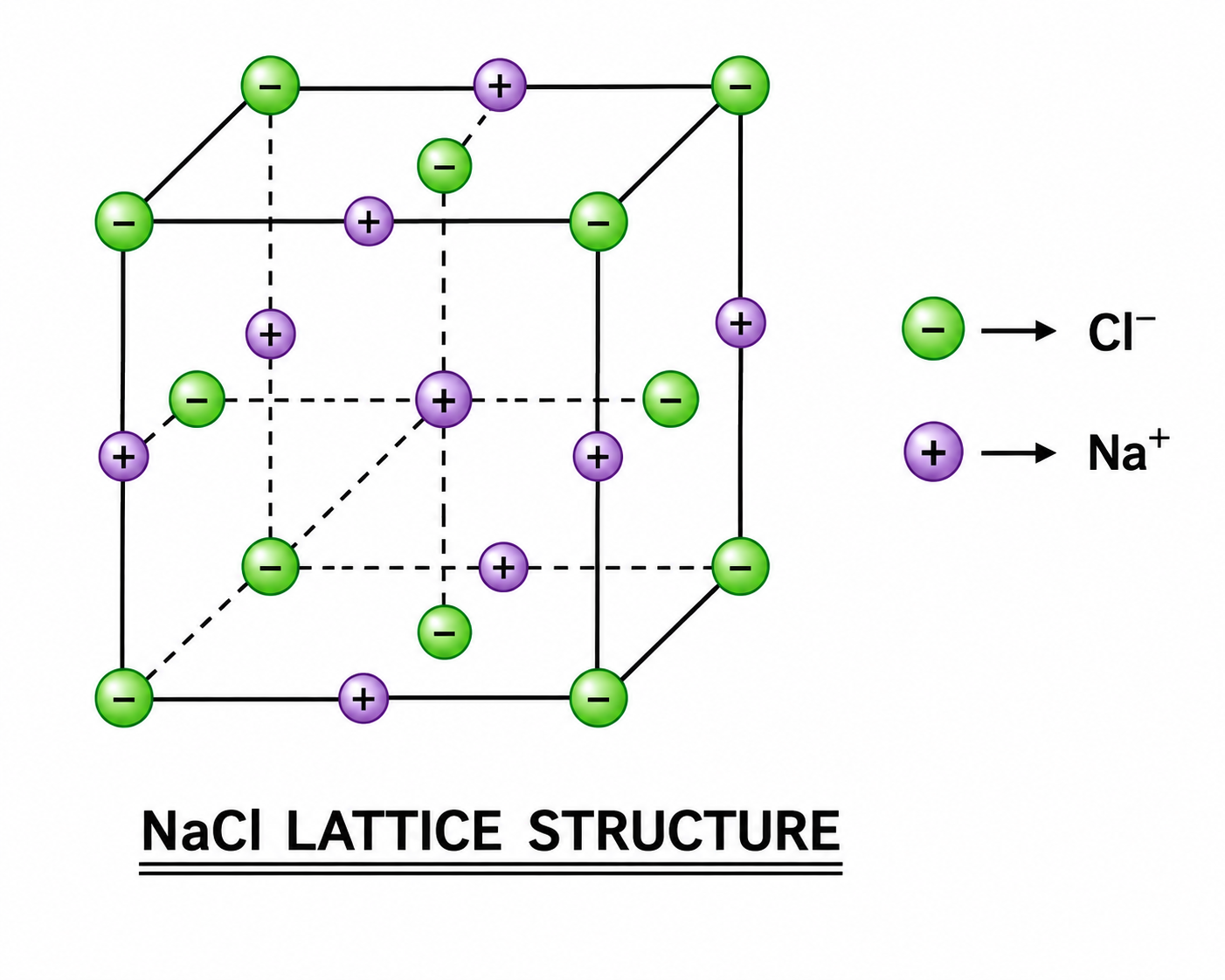
NaCl Crystal Formation
Crystal Structure of NaCl
1. Ionic bonding:-
The primary force holding the ions together is the electrostatic attraction between the positively charged sodium ions and negatively charged chloride ions.
a) Electron transfer:-
When sodium and chlorine atoms come close sodium readily loses its single valence electron and chlorine gains this electron, forming a positively charged sodium ion(Na+) and a negatively charged chloride ion(Cl-).
b) Electrostatic attraction:-
Due to their opposite charges, the Na+ and Cl- ions strongly attract each other, resulting in formation of ionic bond.
2) Lattice formation:-
To minimize repulsion between like charges, the ions arrange themselves in a way, where each positive ion is surrounded by negative ions and vice versa, forming a stable crystal lattice.
a) Cubic lattice:-
The ions arrange themselves in a cubic lattice, meaning they form a regular, repeating pattern in three dimensions.
b) Coordination number:-
Each sodium ion is surrounded by six chloride ions and each chloride ion is surrounded by six sodium ions, giving a coordination number of 6.
c) Face-centered cubic:-
The specific type of cubic lattice in NaCl is called face-centered cubic(FCC), where ions occupy the corners and face centers of the unit cell.
3) Stability:-
This alternating pattern of oppositely charged ions ensures stability and a rigid crystalline structure.
Metal Bond Properties of Metal
1) Metallic bond:-
Definition:-
"When positively charged metal ions are held together by freely moving electrons, the bond formed is called a metallic bond."
2) Properties of metals w.r.t. metallic bonding:-
i- Metallic lustre:-
Metals usually show metallic lustre.
Explanation:-
The outer electrons in a metal are loosely held by the metal's nucleus, allowing them to move freely. These electrons are often called a "sea of electrons". When
light hits the metal, the electrons oscillate and produce their own light. This light reflects back, giving the metal its shiny appearance.
ii- High melting and boiling points:-
Metals have high melting and boiling points.
Explanation:-
Usually, the metallic bonds are strong, requiring a lot of energy to break the bond between the metal ions and the electron sea. The strength of a metallic bond
depends upon two factors:-
a- No. of positive charges present on the positive ions.
b- No. of mobile electrons set free by each atom.
Because of strong metallic bonding, metals have high melting and boiling points.
iii. Good conductors of heat and electricity:-
Metals are good conductors of heat and electricity.
Explanation:-
The presence of freely moving electrons in metals makes them good conductor of heat and electricity. Since the electrons are free to move, they can conduct electricity by moving in response to an electric field. Similarly, when heat is applied, the free electrons absorb and transfer the thermal energy quickly throughout the metal. That's why metals are excellent conductors of both electricity and heat.
iv. Hard and heavy nature:-
Metals are usually hard and heavy.
Explanation:-
In metals, the atoms are strongly held and arranged in the form of rows one above the other. This arrangement makes them hard and heavy.
v. Malleability and ductility:-
Metals can easily be drawn into wire (malleability) and sheets(ductility).
Explanation:-
When pressure is applied on metals, the upper rows of atoms slip pass the lower rows. As a result, their shapes are changed.
Ionic vs Covalent Compound
Comparison between properties of ionic and covalent compounds:-
| Ionic Compound | Covalent Compound |
| 1) Existence: | |
| In ionic compounds, oppositely charged ions are properly arranged to give a crystalline structure. Since the ions are rigid in ionic compounds, such compounds exist in the form of very stable solids. | Covalent compounds are made of two or more non metals. Lower molecular mass covalent compounds are gases or low boiling liquids. High molecular mass covalent compounds exist as solids. |
| 2) Nature of Charge: | |
| As a whole, the ionic compound is neutral. | Covalent compounds mostly exist as discrete neutral molecules. |
| 3) Electrostatic force: | |
| There exists a strong electrostatic force between the ions of ionic compounds. |
There exists a strong electrostatic attraction between the nuclei and the shared electrons. |
| 4) Melting and boiling points: | |
| Ionic compounds are usually solids having high melting and boiling points. The melting point of sodium chloride is 801°C because it is difficult to break the strong electrostatic forces of attraction between the oppositely charged ions. | Generally, the covalent compounds have lower melting and boiling points. For example, water melts at 0°C and boils at 100°C because of relatively weak intermolecular forces between molecules. |
| 5) Solubility: | |
| Ionic compounds are generally soluble in polar solvents ally soluble in polar solvents like water. | They are usually insoluble in water but soluble in non-polar solvents like ether, benzene and acetone. |
| 6) Conductance: | |
| They are usually good conductors of electricity in molten state or in solution form. Their conductance is due to the presence of free ions in these forces. | They are usually bad conductors of electricity. |
Electrical Conductivity of Graphite Crystal
Electrical Conductivity of Graphite Crystals:-
1. Structure:-
Graphite consists of flat layers of carbon atoms arranged in hexagonal rings, with weak Vander Waals forces holding the layers together. Since layers are not bonded strongly, they can slip past each other.
2. Delocalized electrons:-
Moreover, these layers in graphite have mobile electrons in between them. Each carbon atom contributes one electron to a "sea" of delocalized electrons that can move freely within layers.
3. Movement of charge:-
When a voltage is applied, these delocalized electrons can easily move through the graphite structure carrying electrical charge, making graphite a good conductor of electricity.
4. Result:-
Hence the property, known as "delocalized electrons," allows electricity to flow easily through graphite and making it able to be used as an electrode.
Hard and Heavy Nature of Metals
Hard and heavy nature of metals:-
a) Reasons:-
1. Delocalized electrons:-
The free-moving electrons in a metal act like a "sea of electrons," allowing them to move freely between the metal ions, creating a strong electrostatic attraction that holds the lattice together.
2. Metallic bonding resulting in hardness:-
The "sea of electrons" that surrounds the positively charged metal ions in the lattice creates a strong attractive force between them, providing resistance to external forces and contributing to hardness. Moreover, the free electrons within metal exert a significant pressure, which further contributes to the resistance against compression and deformation, making them hard.
3. Atomic structure responsible for high density:-
The nucleus of a metal atom contains a relatively large number of protons, which contribute to the high mass. Moreover, metal atoms tend to arrange themselves in a packed crystal lattice, maximizing the amount of matter in a given space. Hence, metals have a high mass per unit volume (high density), leading to their "heavy" nature.
b) Conclusion:-
Metals are typically hard and heavy because of their unique atomic structure, where metal atoms are tightly packed together in a crystal lattice, with their outer electrons delocalized and freely moving throughout the structure, creating a strong "sea of electrons" that holds the atoms firmly together, resulting in high density and hardness.
Bonding in Al₂Cl₆ molecules
Bonding in A Al₂Cl₆ molecules
1) Dimerization of AlCl₃:-
In the vapour phase, aluminium chloride AlCl₃) exists as a dimer Al₂Cl₆. This is because AlCl₃ molecule are electron-deficient and tend to stabilize by forming coordinate covalent bonds.
2) Formation of Coordinate Covalent bonds:-
In AlCl₃ aluminium has only 6 electrons in its valence shell, leaving it electron-deficient. Chlorine atoms have lone pairs of electrons which they can donate to aluminium atom forming a coordinate covalent bond. This electron donation leads to formation of dimeric structure of Al₂Cl₆, where two AlCl₃ molecules share two chlorine atoms as a bridge
3) Structure of Al₂Cl₆:-
The structure of Al₂Cl₆ consists of two aluminium atoms bonded to three terminal chlorine atoms each and two shared chlorine atoms. These shared chlorine atoms create the bridge between the two AlCl₃ units.
4) Stability:-
This dimeric structure minimizes electron deficiency of the aluminium atoms, making the molecule more stable in the vapour phase.
Structure of Sand (SiO₂)
Structure of Sand (SiO₂)
1. Molecular structure:-
Silicon dioxide (SiO₂), commonly known as sand, has a three-dimensional network structure. In this structure, each silicon atom is covalently bonded to four oxygen atoms in a tetrahedral arrangement. Each oxygen atom is shared between two silicon atoms forming a continuous network of Si-O bonds.
— Si — O — Si — O — Si —
| | |
O O O
| | |
— Si — O — Si — O — Si —
| | |
O O O
Structure of SiO₂
2. Tetrahedral bonding:-
In SiO₂, each silicon atom is at the centre of a tetrahedron, formed by four oxygen atoms. The oxygen atoms, in turn, are bonded to two silicon atoms. This bonding creates a strong, rigid and extensive network structure throughout the material.
3. Crystal lattice:-
SiO₂ forms a crystalline solid structure in its pure form. This crystal lattice extends in all directions, making the material hard and giving it high melting and boiling points. The lattice structure is highly stable and contributes to strength and durability of sand.
4. Properties of sand:-
Due to strong covalent bonds between silicon and oxygen, SiO₂ is chemically inert, resistant to weathering and insoluble in water. The structure ofSiO₂ also explains its transparency in its most common forms and its use in various industries like glass-making.