Chapter 2 - Atomic Structure
Comprehensive Questions & Answers for Class 9 Chemistry (Punjab Board)
Mass Concentration in the Nucleus
Almost all mass of an atom is concentrated in its nucleus.
Reason:
- Although the nucleus is less than one hundred thousandth (1/100,000) of the size of an atom, it contains more than 99.9% of the mass of an atom.
- An atom contains three subatomic particles: electron, proton and neutron.
- The nucleus contains the subatomic particles protons and neutrons.
- The mass of the nucleus is the sum of the masses of protons and neutrons, which are located at the centre of the atom.
- Electrons present outside the nucleus have negligible mass.
Therefore, almost all the mass of an atom is concentrated in its nucleus.
Difference Between Elements
Elements are different from one another.
Reason:
- The number of protons in an atom define the feature of atom.
- The proton number is equal to atomic number.
- Each element has different atomic number.
- These properties makes one element differs from one another.
Number of Neutrons
Solution:
Given:
-
Mass number = A = 210
-
Atomic number = Z = 83
To find:
Number of neutrons = ?
Calculation:
Number of neutron = mass number − atomic number
So, there are 127 neutrons in ²¹⁰₈₃Bi
Radioactivity of Tritium
Reason:
- Tritium is a radioactive element.
- Tritium has unstable nucleus.
- It contains two neutrons and one proton which makes its nucleus unstable.
- It decays into Helium-3 by emitting beta radiation, making it radioactive isotope.
Nuclear Equation:
³₁H → ³₂He + ⁰₋₁e
Tritium → Helium → Beta particle
Absorption and Emission of Energy
Absorption of Energy:
An atom absorbs energy when electrons in lower energy level move to higher energy level from an external source like heat or light.
Emission of Energy:
An atom emits energy when electrons in higher energy level jumps into lower energy level by releasing the absorbed energy in form of light or other types of radiations.
Increase in Electron Energy Between Shells
Lowering Pressure in Discharge Tube
Lowering pressure of gas inside discharge tube reduces number of collisions between gas particles, allowing electrons to move more freely and easily ionize atoms, which makes it easier to observe behaviour of gases.
Classical Concept and Quantum Mechanical Model of Electron
Instability of Radioactive Nuclei
The nuclei of radioactive elements are unstable.
Reason:
- They have an imbalanced ratio of protons to neutrons.
- This causes an excess of internal energy within the nucleus, which disrupts the balance of forces holding nucleus together.
- This imbalance leads to emission of radiations as nucleus tries to become stable through radioactive decay.
Discovery of Electrons and Protons in All Elements
During discharge tube experiments, scientists concluded that same type of electrons and protons are present in all elements.
Reason:
- Discharge tube experiment showed that atoms are no longer smallest particles of matter.
- Rather they are made up of still smaller particles like electrons and protons.
- Electrons and protons are shown to be present in all elements irrespective of fact that elements behave differently.
Structure of Hydrogen Atom
Hydrogen Atom:
A hydrogen atom is made up of a single proton and single electron. It is the simplest atom and has a spherical symmetry.
Structure of Hydrogen Atom:
- The hydrogen atom's nucleus contains a positively charged proton.
- The electron is negatively charged and is bound to nucleus by Coulomb's force.
- The hydrogen atom is electrically neutral.
- Its atomic number is 01.
- Its mass number is 1.008 amu.
Isotopes of Hydrogen Atom:
Hydrogen has three isotopes:
- Protium: ¹₁H
- Deuterium: ²₁H
- Tritium: ³₁H
The most common isotope of hydrogen is Protium: ¹₁H
(1) Protium ¹₁H
Protium has one proton and no neutron.
(2) Deuterium ²₁H
Deuterium has one proton, one electron and one neutron.
(3) Tritium ³₁H
Tritium has one electron, one proton and two neutrons. Tritium is radioactive.
Structure of Hydrogen Isotopes:
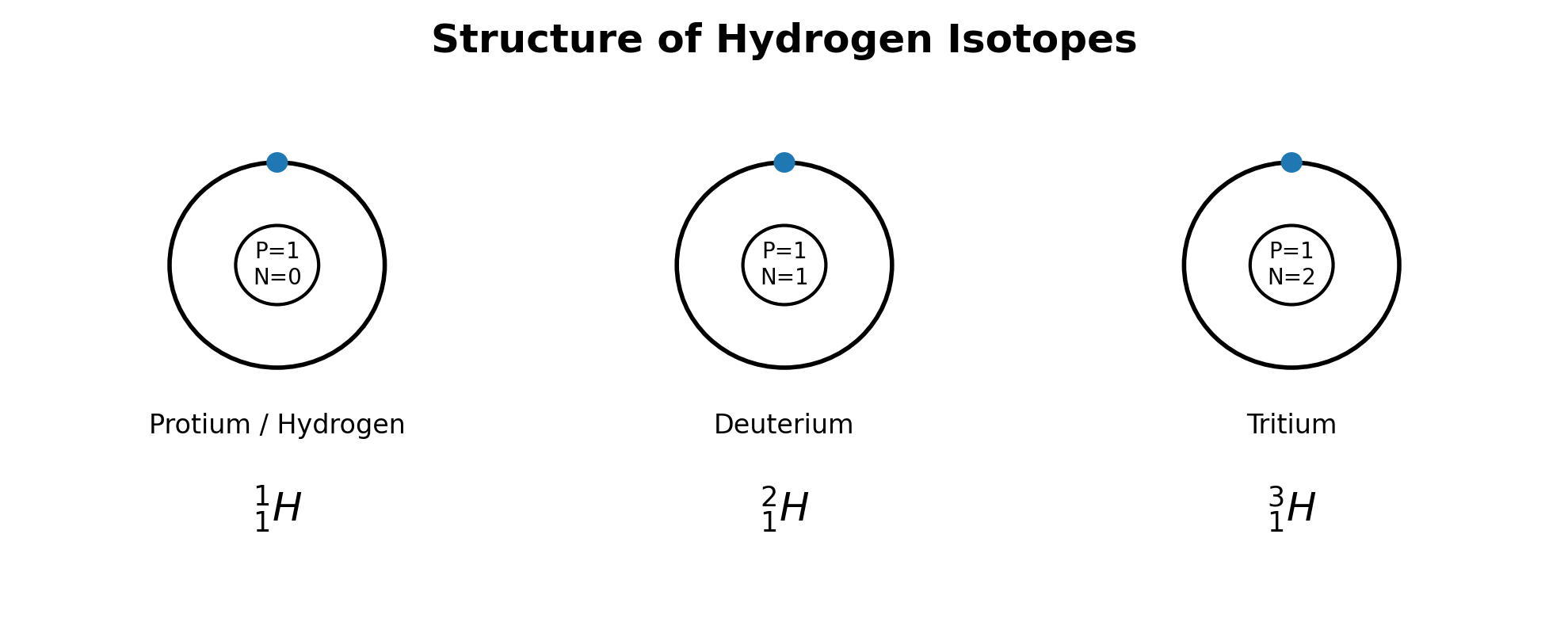
Protium / Hydrogen
¹₁H
-
Protons = 1
-
Neutrons = 0
-
Electrons = 1
Deuterium
²₁H
-
Protons = 1
-
Neutrons = 1
-
Electrons = 1
Tritium
³₁H
-
Protons = 1
-
Neutrons = 2
-
Electrons = 1
Ionization of Atoms by Radioactive Source
Ionization of Atoms by Radioactive Source:
- Radiations emitted from a radioactive source cause atoms to ionize.
- This ionizing radiation should have enough energy to remove the tightly bound electrons from orbit of an atom.
- Electron can be lost because an ionizing radiation collides with the atom and forces the electrons away from the atom.
- This process converts the atom into a positively charged ion (cation).
Example:
If an atom of sodium is hit by an ionizing radiation, it may lose an electron and will convert into a positively charged ion (cation).
Equation:
Na → Na⁺ + e⁻
Na⁺ = Cation
Radioactivity & Applications of Radioactive Isotopes
Radioactivity:
a) Definition:
The phenomenon of emission of radiation by unstable nuclei is called radioactivity.
b) Explanation:
• Some isotopes are unstable.
• Their nuclei do not have enough binding energy to hold them together.
• This causes them to release excess energy in the form of radiation.
• This release of energy is called radioactivity.
Applications of Radioactive Isotopes:
1- Medical Applications:
(i) Medical Imaging:
Radioactive isotopes such as Technetium-99m are used in diagnostic imaging of human organs like brain, lungs and other. A small amount of radioactive fluid is injected into patient, and a special camera tracks its movement to diagnose disease.
ii- Treatment of Disease:
Radioactive isotopes are used to treat various medical conditions, including cancer and thyroid disease.
2- Radio carbon Dating:
(i) Age determination of historical objects:
Radioactive carbon-14 (C¹⁴) is used to determine the age of historical objects.
(ii). Age Determination of dead Organism:
The methods involving measuring amount of ¹⁴C in a sample from dead plants or animals, such as wood or bones, to estimate when organism died. The older, the sample, the less ¹⁴C it contains.
3- Industrial Applications:
i. Testing Material Strength:
Radioactive isotopes are used to test strength of metal and concrete mixture.
Oil Exploration:
They are used to locate oil fields.
4- To calculate relative atomic mass of mercury we use formula for weighted average.
Relative atomic mass = Σ (isotopes mass × isotope abundance/100)
Relative atomic mass = (196 × 0.000146) + (198 × 0.001) + (1999 × 0.1624) + (200 × 0.2313) + (201 × 0.1292) +(202 × 0.2986) + (204 × 0.0699)
= 20.616 + 19.768 + 32.535 + 42.66 + 26.599 + 60.262 + 11.976
= 227.94
Therefore, relative atomic mass of mercury is approximately 227.954 amu.
Synthesize Elements in Laboratory
Existence of Solar System in an Atom
This system refers to Bohr's model of atom where electrons revolve around the nucleus in fixed orbit, similar to how planets revolve around the sun. However, this is similied because electron don't follow exact circular path as planets do.
Calculation of Number of Proton, Neutron and Electron
1. Platinum (¹⁹⁵₇₈Pt):
Given data:
Atomic Number (Z) = 78 (This is the number of protons)
Mass Number (A) = 195
To find:
No of protons = ?
No of neutrons = ?
No of electrons = ?
Calculation:
No of protons = 78 (no of proton is equal to atomic number)
No of electrons = 78 (no of electrons is equal to no. of protons)
No of neutrons = Mass number - Atomic number
= 195 - 78
= 117
2. Manganese (⁵⁵₂₅Mn):
Given data:
Atomic number (Z) = 25
Mass number (A) = 55
To find:
No of proton = ?
No of electrons = ?
No of neutrons = ?
Calculation:
No. of proton = 25 (no. of proton is equal to atomic number)
No. of electron = 25 (no. of electron is equal to the no. of protons)
No. of neutron = Mass number - Atomic number
= 55 - 25
= 30
3. Iodine (¹²⁷₅₃I):
Given data:
Atomic number = 53
Mass number = 127
To find:
No. of protons = ?
No. of electrons = ?
No. of neutrons = ?
Calculation:
No. of electrons = 53 (no. of electrons is equal to no. of proton)
No. of neutron = Mass number - Atomic number
= 127 - 53
= 74
Physical & Chemical Properties of Isotopes of an Element
Similar Chemical Properties:
Isotopes of an element show the same chemical properties because they have same number of electrons.
Different Physical Properties:
Their physical properties differ due to variations in their mass and the number of neutrons, which affect properties like density, melting point and stability.
Radioactive Isotope
A radioactive isotope emit radiation.
Reason:
The nucleus of radioactive isotopes is unstable.
To achieve stability, it release excess energy in the form of radiation through a process called radioactive decay.
Examples of Radioactive Isotopes
• Uranium - 238 (²³⁸₉₂U) disintegrates to form Thorium - 234 (²³⁴₉₀Th)
• Thorium, eventually transforms into lead - 206 (²⁰⁶₈₂Pb)
• Lead is a stable atom.
Comparison: Cl : Mg
Magnesium:
Relative atomic mass of Mg is 24.305 amu
Chlorine:
Relative atomic mass of Cl is 35.45 amu.
Comparison: Cl : Mg
35.45 amu : 24.305 amu
35.45
-------
24.305
1.46
Thus, a chlorine atom is approximately 1.46 times heavier than magnesium atom.
Calculate the relative atomic mass of lead (Pb)
Given data:
Isotopes of Pb: ²⁰⁴Pb, ²⁰⁶Pb, ²⁰⁷Pb, ²⁰⁸Pb
Isotopes masses: 204, 206, 207, 208
Isotopes Abundance: 2.0%, 24%, 22.0%, 52.0%
To find:
Relative Atomic Mass (RAM) = ?
Calculation:
RAM = (m₁ × P₁) + (m₂ × P₂) + (m₃ × P₃) + (m₄ × P₄)
----------------------------------------------------------
100
RAM = (204 × 2.0) + (206 × 24.0) + (207 × 22.0) + (208 × 52.0)
----------------------------------------------------------
100
RAM = 408 + 4944 + 4554 + 10816
----------------------------
100
RAM = 20722
-----
100
RAM = 207.22