Chapter 11 - Hydrocarbons
Comprehensive Questions & Answers for Class 9 Chemistry (Punjab Board)
Reactivity of Alkanes
Alkanes show least reactivity towards other compounds because they have only strong single covalent C-H and C-C bonds. . Although they react with halogens and undergo combustion reactions.
Explosion of Natural Gas
A mixture of natural gas (methane) and air may explode when ignited. This is the main cause of explosion at homes where gas leakage occurs.
Organic vs Inorganic Compounds
Generally organic compounds have low melting and boiling points and are volatile in nature because they have weak intermolecular forces. Inorganic compounds, on the other hand, have comparatively high melting and boiling points.
Chemical Reaction of Alkanes & Role of Sunlight in Halogenation
Sunlight provides energy in the form of hv. It produces free chlorine radicals which start the substitution reaction called Halogenation.
Reactions:
- CH₄ + Cl₂ ---hv----> CH₃Cl + HCl
(Chloromethane / Methyl chloride)
- CH₃Cl + Cl₂ ---hv----> CH₂Cl₂ + HCl
(Dichloromethane)
- CH₂Cl₂ + Cl₂ ---hv ----> CHCl₃ + HCl
(Trichloromethane / Chloroform)
- CHCl₃ + Cl₂ ---hv----> CCl₄ + HCl
(Tetrachloromethane / Carbon tetrachloride)
Boiling Point of n-butane vs iso-butane
The boiling point of n-butane is 1°C and the boiling point of iso-butane is -11.7°C.
Solubility of Organic Compounds
Organic compounds are not soluble in water because they are non-polar while water is a polar solvent.
Importance of Organic Compounds
Definition:
The branch of chemistry which deals with the study of hydrocarbons and their derivatives is known as Organic Chemistry.
Importance:
- Organic compounds are famous for their Due to large number and diverse behaviour.
- Several million organic compounds are known to exist naturally or have been synthesized in the laboratory.
- Organic compounds are large and more complex in nature.
- They include biomolecules like proteins, enzymes, carbohydrates, lipids, vitamins and nucleic acids, pharmaceuticals, and synthetic fibres, etc.
Importance of Carbon Element
The element carbon is so important due to the following reasons:
- The element carbon is present at the centre of the periodic table and it is generally not possible for it to gain or lose electrons to form ionic bonds.
- Therefore, it forms four covalent bonds. Because of its small size, these covalent bonds are short and strong. This enables carbon to form strong and stable bonds with itself and with hydrogen, oxygen and nitrogen.
- The self linking property of carbon is called catenation. And due to this it forms long, straight and branched chains and rings.
- Carbon atom mostly forms covalent bonds with other carbon, hydrogen, oxygen, nitrogen and halogens.
- Compounds in which carbon forms single bonds with other atoms are called saturated compounds.
- These compounds are generally represented by their structural formulas.
Methane, a saturated compound, is represented by the following structural formula
H
|
H - C - H
|
H or its condensed form is CH₄
- A structural formula thus shows the symbols for the atoms present in the compound connected by short lines which represent the bonds present in them.
- Other Examples of Saturated Compounds are C₂H₆, CH₃Cl, CH₃OH, CH₃NH₂ , etc.
Functional Group in Alkanes vs Alkenes
In alkanes, C-C single bond is very strong and non-reactive. So it does not behave as a functional group. While in alkenes, C=C double bond is reactive and gives addition reactions. That’s why it is called a functional group.
Electron Dot & Cross Structure of Alkanes
Electron Cross and Dot Structures of Alkanes:
Methane:
Structural Formula:
H
|
H - C - H
|
H
Electron Dot Structure:
H
x
H x C x H
x
H
Ethane:
Structural Formula:
H H
| |
H - C - C - H
| |
H H
Electron Dot Structure:
H H
x x
H x C . . C x H
x x
H H
Propane:
Structural Formula:
H H H
| | |
H - C - C - C - H
| | |
H H H
Electron Dot Structure:
H H H
x x x
H x C . C . C x H
x x x
H H H
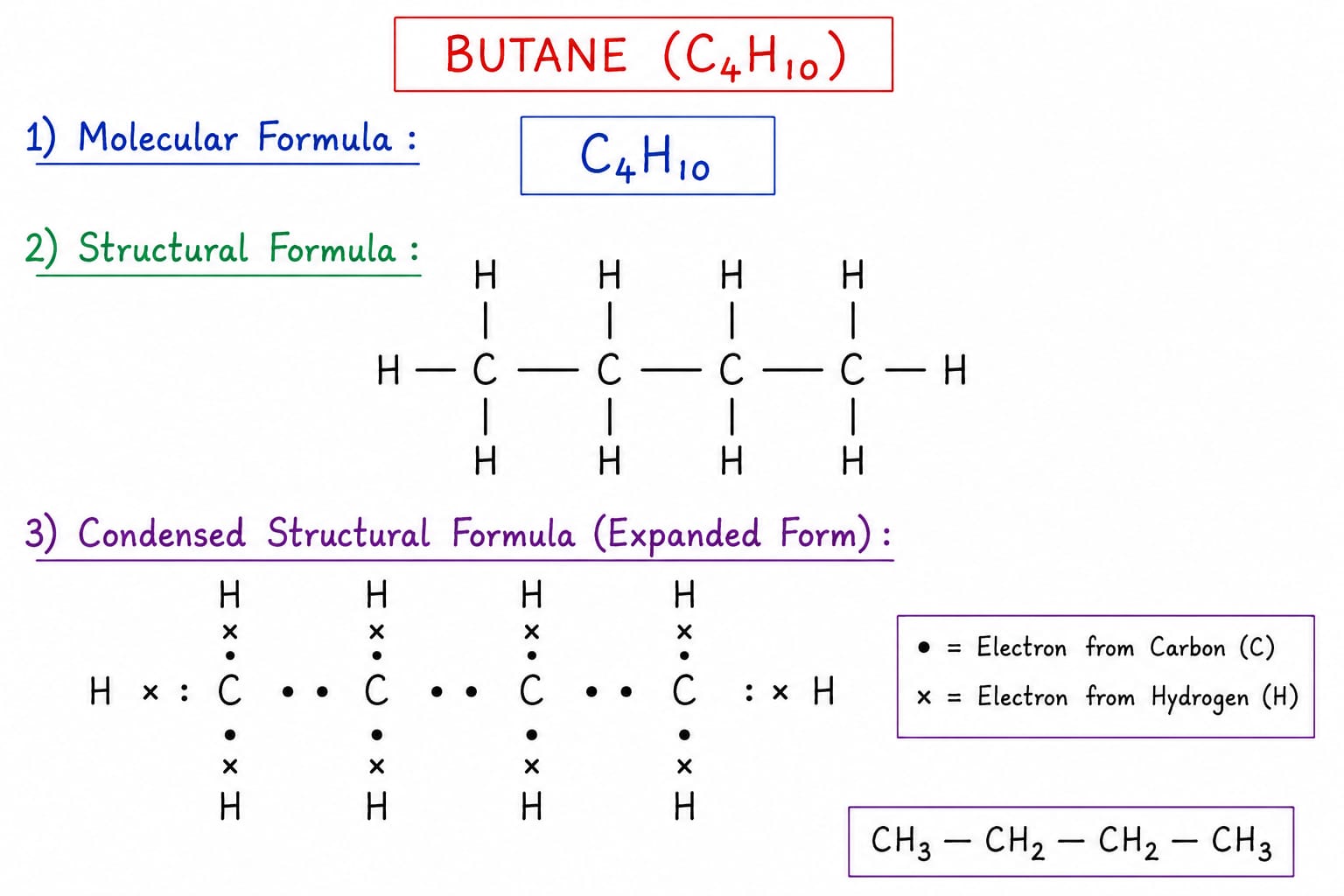
Butane:
Structural Formula:
H H H H
| | | |
H - C - C - C - C - H
| | | |
H H H H
Electron Dot Structure:
H H H H
x x x x
H x C . C . C . C x H
x x x x
H H H H
Combustion Reaction of Alkanes
Alkanes burn in oxygen or air to form CO₂ and H₂O with the evolution of large amount of heat. The reaction is called combustion.
Examples:
Methane:
CH₄(g)+2O₂(g) ⟶ CO₂(g)+2H₂O(g)+heat
Ethane:
2C₂H₆(g)+7O₂(g) ⟶ 4CO₂(g)+6H₂O(g)+heat
Uses of Alkanes:
- Natural gas, which is chiefly methane, is used as domestic fuel.
- Compressed natural gas (CNG) is used as automobile fuel.
- These gases are used in the manufacture of chemicals such as carbon black, methyl alcohol, ethyl alcohol, chloroform, carbon tetrachloride etc.
Explosion Due to Open Natural Gas Valve
If the natural gas valve is left open in the kitchen it causes an explosion if there is fire or a spark because when natural gas mixes with air and it forms a flammable mixture. It can be prevented immediately by closing the valve, opening the window for ventilation and avoiding turning any electrical switch on and off or lighting a fire.
Benefits of "Neem"
Neem is used for skin problems, blood purification, wounds and to reduce fever because it has antibacterial, antifungal and anti-inflammatory properties.
Famous Medicines as Organic Compounds
Famous medicines that are actually organic compounds include Paracetamol, Penicillin, Aspirin and Vitamin C. All of these are carbon based organic compounds.
Organic vs Inorganic Compounds
| Organic Compound | Inorganic Compound |
| Organic chemistry deals with the study of carbon compounds and their derivatives | Inorganic chemistry deals with the study of inorganic compounds |
|
Examples: Biomolecules like proteins, enzymes, lipids, carbohydrates, and fibers etc |
Examples: Ionic compounds like carbonates, carbides, cyanides and oxides of carbon are classified as inorganic compounds. |
Reason for Large Number of Organic Compounds
The self-linking property of carbon called catenation. Due to this, it forms long, straight and branched chains and rings.
Products from Controlled Oxidation of Natural Gas
When natural gas, mainly methane is oxidized under controlled conditions, it gives following products:
- Methanol
- Formaldehyde
- Formic Acid
Decomposition of Naphtha Fraction
Fractional distillation of petroleum gives naphtha which consists of a mixture of liquid hydrocarbons. It is then heated at around 500°C in the presence of catalyst called zeolite to give hydrocarbons which have five carbon atoms.
Naphtha ---- heatzeolite ---->Alkanes and Alkenes
(mixture of hydrocarbons) (containing 5 to 10 carbon atoms)
Molecular, Structural and Condensed Structural Formula For Iso- Butane
Molecular, structural and condensed structural formula for Iso-Butane :
Uses of Organic Compounds
Because these compounds are part of everything from food we eat to the various items we use in daily life to fulfill our needs.
Uses:
- As Food: Carbohydrates, Proteins, Fats, Vitamins
- As Clothing: Cotton, Wool, Silk, Synthetic fibers
- As Shelter/Houses: Wood, Plastic, Paint
- As Fuel: Petrol, Diesel, LPG, Natural Gas, Coal
- As Medicines: Aspirin, Antibiotics, Vitamins
- As Raw Material: Plastics, Soap, Cosmetics, Dyes
Naturally Occurring Organic Compounds
Five Naturally Occurring Organic Compounds are:
- Vitamins
- Enzymes
- Lipids/Fats
- Carbohydrates
- Proteins
IUPAC Nomenclature
IUPAC name of the given compound is 2-Methylbutane.
Physical Properties of Alkanes
The melting and boiling points of alkanes increase regularly with the increase of molecular size. This is because of increase of attractive forces between the molecules of alkanes.