Chapter 2 - Kinematics
Comprehensive Questions & Answers for Class 9 Physics (Punjab Board)
Scalar Quantity & Vector Quantity with Examples:
Scalar Quantity:
A scalar is that physical quantity which can be described completely by its magnitude only.
Examples:
• Mass
• Temperature
Vector Quantity:
A vector is that physical quantity which needs magnitude as well as direction to describe it completely.
Examples:
• Velocity
• Force
Five Examples of Vector & Scalar Quantities
Vector Quantities
Examples:
(i) Displacement
(ii) Force
(iii) Velocity
(iv) Acceleration
(v) Momentum
Scalar Quantities
Examples:
(i) Mass
(ii) Temperature
(iii) Time
(iv) Distance
(v) Energy
Vector Addition (Head To Tail Rule)
Head-to-Tail Rule
Statement:
To add a number of vectors, redraw their representative lines such that the head of one line coincides with the tail of the other. The resultant vector is given by a single vector which is directed from the tail of the first vector to the head of the last vector.
Distance & Speed -Time Graph
Distance-Time Graph:
Distance-time graph shows the relation between distance (s) and time (t) taken by a moving body.
Slope:
The slope of the graph represents speed.
Speed-Time Graph:
Speed-time graph shows the relation between speed (v) and time taken by a moving body.
Falling Objects and Acceleration Due to Gravity
No, a heavier object will not fall faster than a lighter object.
Reason:
Heavier and lighter objects fall at the same rate near the Earth's surface, assuming air resistance is negligible. This is because the acceleration due to gravity is the same for all objects regardless of their mass.
Indication of Direction in Vector Quantities
Indication of Vectors:
When vector quantities are written in scalar notation (non-bold), the direction is typically indicated by a symbol such as an arrow (→).
Acceleration with Constant Velocity and Constant Speed
Constant Velocity:
No, a body cannot have acceleration if it is moving with constant velocity because acceleration requires a change in velocity (magnitude or direction).
Constant Speed:
Yes, a body can have acceleration while moving with constant speed if it changes direction (e.g., moving in a circular path). This is called centripetal acceleration.
Uniform Speed and Uniform Velocity
No, the velocity will not be uniform if the direction of motion changes.
Reason:
Velocity is a vector quantity that depends on both magnitude and direction. Therefore, for velocity to be uniform, both magnitude and direction must remain constant.
Distance and Displacement
Distance and displacement may or may not be equal in magnitude.
Explanation:
In certain situations, the total distance travelled by an object and its displacement can be the same. In most cases, the distance travelled is greater than the displacement because the object may move along a curved path, making the actual path longer than the shortest distance between two points. Therefore, displacement is always less than or equal to the distance travelled.
Muzzle Velocity and Acceleration of a Bullet
Acceleration of the bullet is larger in the gun with the shorter barrel.
Reason:
Because the bullet accelerates over a shorter distance and, according to the equation:
vf² − vi² = 2as
a greater acceleration is required to achieve a higher velocity in a shorter distance.
Average Velocity and Instantaneous Velocity
Yes, it is possible for the instantaneous velocity to be negative at certain points even if the average velocity is positive.
Justification:
The average velocity depends on the total displacement, but instantaneous velocity can be negative if the object is moving in the opposite direction during certain intervals of the trip.
Velocity–Time Graph of a Vertically Thrown Ball
The graph correctly represents the motion.
Explanation:
In graph C, the velocity is maximum at zero time. While going up, its acceleration due to gravity is negative. At half time of flight, its velocity becomes zero. It comes back downward and returns to the ground with velocity equal to the initial velocity in magnitude.
Calculation of Velocities (Segments a, b & c)
Possibility of Velocity & Acceleration opposite behaviour at Time Instant
Yes, it is possible that the velocity of an object is zero at an instant of time.
Example:
A ball is thrown vertically upward. At the highest point , the velocity is zero but acceleration is still 9.8 metre per second downward due to gravity.
Graphical Representation of Vector
A vector is graphically represented by a straight line with an arrow at one end.
Magnitude:
The length of the line represents the magnitude of the vector according to a suitable scale.
Direction:
The direction of the arrow indicates the direction of the vector.
Reference Axes:
Vectors are often represented with respect to two mutually perpendicular reference axes.
These axes are typically:
(i) x-axis : Horizontal axis
(ii) y-axis : Vertical axis
The point where these axes meet is called the origin, usually denoted as O.
Representation of Axes:
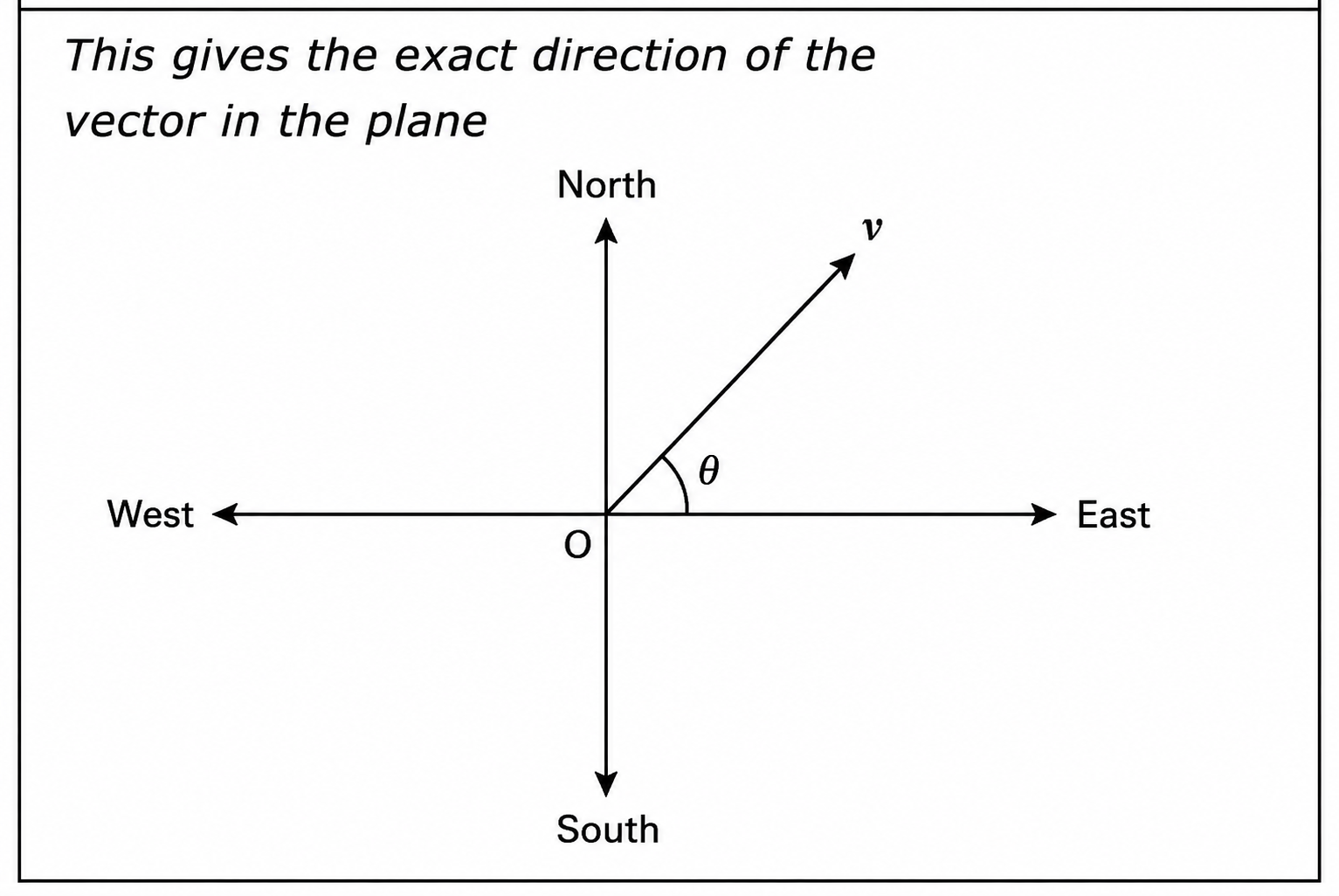
To represent the direction, two mutually perpendicular lines are required. We can draw one line to represent east-west direction and other line to represent north-south direction.
The direction of the vector can be given with respect to these lines.
The direction of the vector is also described with respect to the reference axes, often using an angle (θ).
The angle (θ) is measured counterclockwise from the positive direction of the x-axis.
Rest VS Motion and Speed VS Velocity
(i) Rest:
Definition:
If a body does not change its position with respect to its surroundings, it is said to be at rest.
Example:
If a motorcyclist is standing on the road and observer will notice that the motorcyclist is not changing his position relative to nearby object such as a building, tree, or electric pole.
In this case, the motorcyclist is considered to be at rest.
(ii) Motion:
Definition:
If a body continuously changes its position with respect to its surroundings,
It is said to be in motion.
Example:
When the motorcyclist starts driving the observer will see that motorcyclist is moving relative to the nearby buildings, tree or electric pole. This means the motorcyclist is in motion.
2. Speed and velocity:
Speed:
Speed is the rate at which a body covers a distance in given time. It is a scalar quantity, which means it has magnitude but no direction.
Formula:
The speed v is calculated as:
speed=DistanceTime\text{speed}=\frac{\text{Distance}}{\text{Time}} v=stv = \frac{s}{t}
where:
- s = distance covered
- t = time taken
Unit:
SI unit of speed is meter per second or kilometers per hour.
Velocity:
The net displacement of a body in unit time is called velocity.
Formula:
Velocity (v) = Displacement/Time
where;
Displacement =d and Time =t
where displacement refers to the shortest straight-line between the starting and ending points, including directions.
Unit:
SI unit of velocity is also metre per second.
Types & Examples of Motion
Types of Motions:
In daily life, we observe the main types of motion.
i) Translatory Motion
ii) Rotatory Motion
iii) Vibratory Motion
i- Translatory Motion :
"If every particle of a body moves uniformly in the same direction, the motion is called translatory mation.
Examples:
The motion of a train or a car.
Types of Translatory Motion:
a) Linear Motion:
When a Car moves along a straight line, its motion is called Linear motion.
Example:
A freely falling object.
b) Circular Motion:
When a body moves along a circular path, its motion called circular motion.
Examples:
i). A ball tied to a string and whirled.
ii). A Ferris wheel.
c) Random Motion:
When a body moves along an an irregular or unpredictable path,its motion is called random motion.
Example :
The movement of a butterfly.
ii- Rolatory Motion:
If every point of a body moves around a fixed axis, the motion is called rotatory motion.
Examples:
i- The blades of an electric fan.
ii- The drum of a washing machine dryer.
iii- A spinning top.
iii- Vibradory Motion:
When a body repeats its to and fro motion about a fixed position, the motion is called vibratory motion.
Examples:
i- A Swing in a park.
ii- The vibration of a guitar string.
Comparison between Distance & Displacement
|
|
Feature |
Distance |
Displacement |
|
1. Definition |
Distance is the total length of the actual path travelled by an object during its motion. |
Displacement is the shortest straight-line distance between an object's initial and final positions. |
|
2. Type |
Distance is a scalar quantity which means it has only magnitude and no direction. |
Displacement is a vector quantity which means it has both magnitude and direction. |
|
3. Path Dependency |
It depends on the path taken. |
It is independent of the path taken. |
|
4. SI Unit |
Its SI unit is metre (m). |
Its SI unit is also metre (m). |
|
5. Example |
If a person travels from Multan to Lahore by car and the speedometer shows 320 km, this is the distance travelled. It accounts for all the curves and turns along the journey and is not necessarily the shortest path. |
If a car travels from position A to B, the displacement is the straight line distance between A and B directed from A to B. This line represents the shortest path, regardless of the actual curved path travelled.
|
Gradients of Distance & Speed-Time Graph
Distance-Time graph:
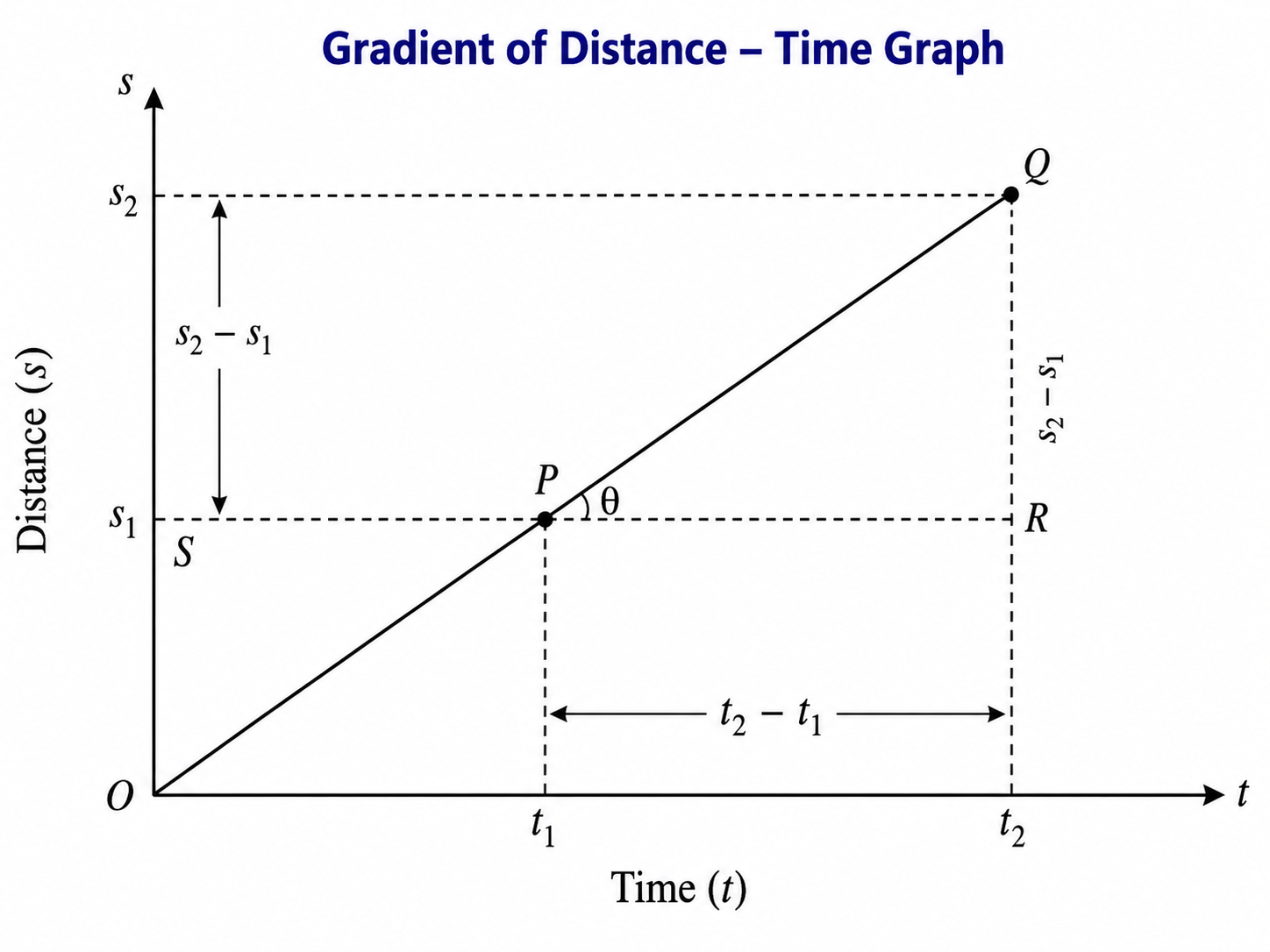
The gradient of a distance-time graph represent the rate of change of distance with respect to time. This is equivalent to average speed of the body during the given time interval. A steeper gradient indicates a higher speed while a flater gradient indicates a lower speed.
Calculation of Gradient (Slope):
The gradient (slope) is given by:
Gradient = change in distance(s)/change in time(t) = s2 - s1/t2 - t1 =s/t
Relate to Average Speed:
From the formula;
Gradient = s/t = v
where v is the average speed of the body.
Graphical Interpretation:
The gradient equals tanθ where θ is the angle formed by the graph with the horizontal axis.
Hence, Gradient = tanθ = v
In conclusion, the gradient of distance time graph is equal to the average speed of the body.
Gradient of Speed–Time Graph:
The gradient (slope) of a speed–time graph indicates the average acceleration of an object. It represents the rate of change of speed with respect to time.
Formula for Gradient:
The gradient is calculated as:
Gradient = change in speed (ΔV)/change in Time (Δt) =V₂-V₁/t₂-t₁ = a
where,
(i) V₂ and V₁ are speeds at times t₂ and t₁ respectively.
(ii) a is the average acceleration.
Case 1: Motion with Constant Acceleration
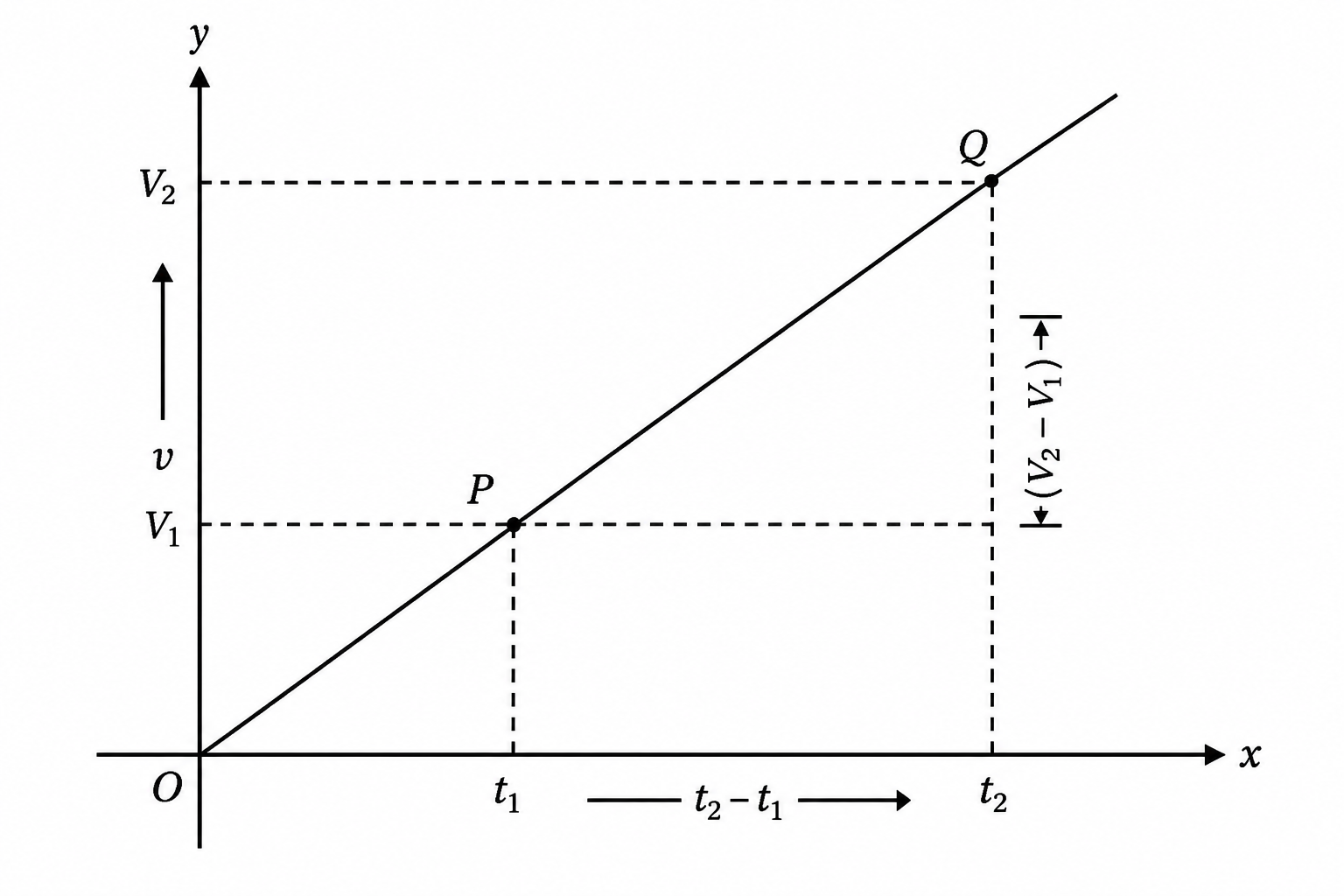
A positive Gradient indicates constant acceleration.
Case 2: Motion with constant speed
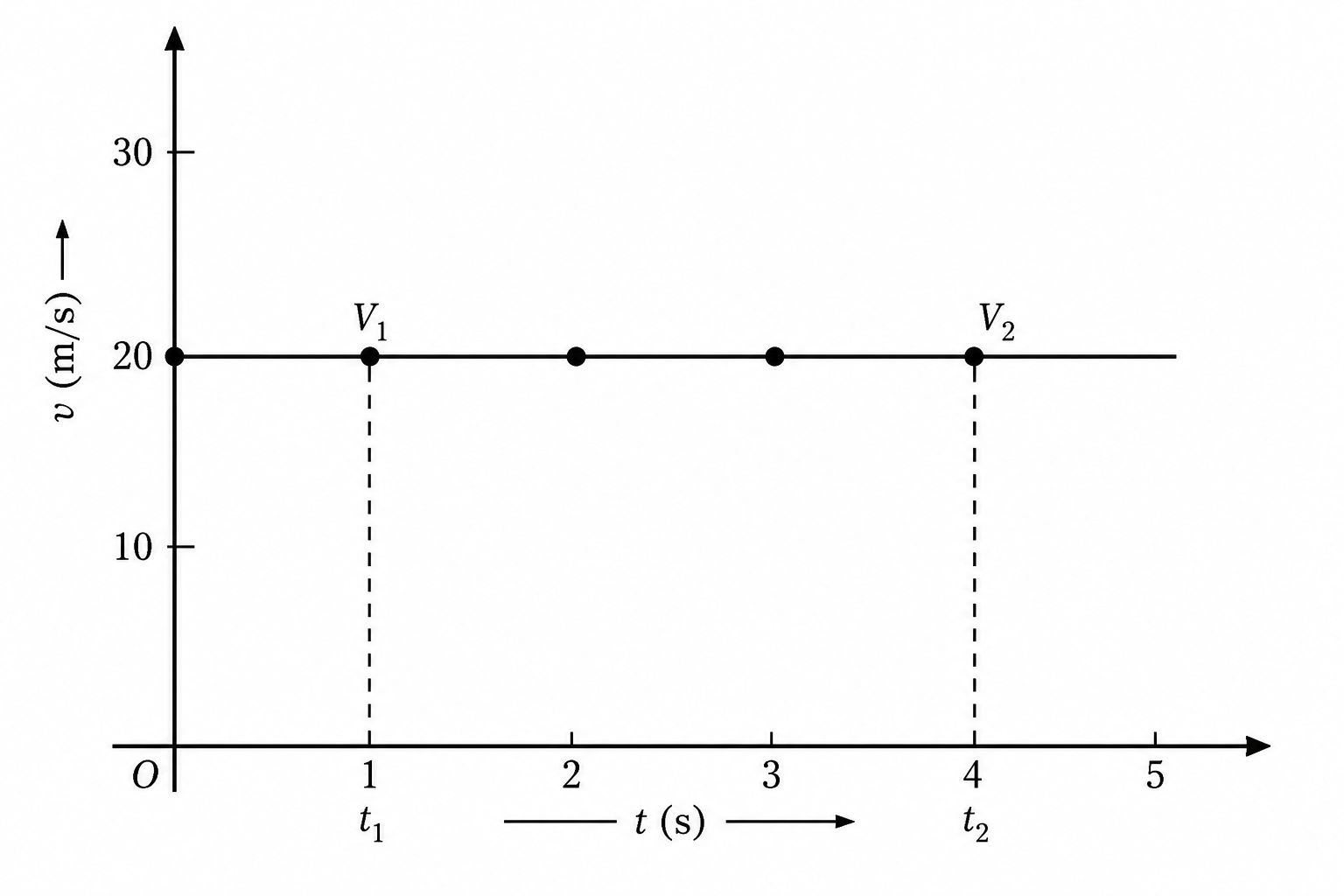
A zero gradient indicates motion aat constant speed with zero acceleration.
Area under Speed-Time Graph
Area under Speed-Time Graph
The area under a speed-time graph represents the distance travelled by an object during a given time interval. It is calculated by finding the geometric area under the curve up to the time axis.
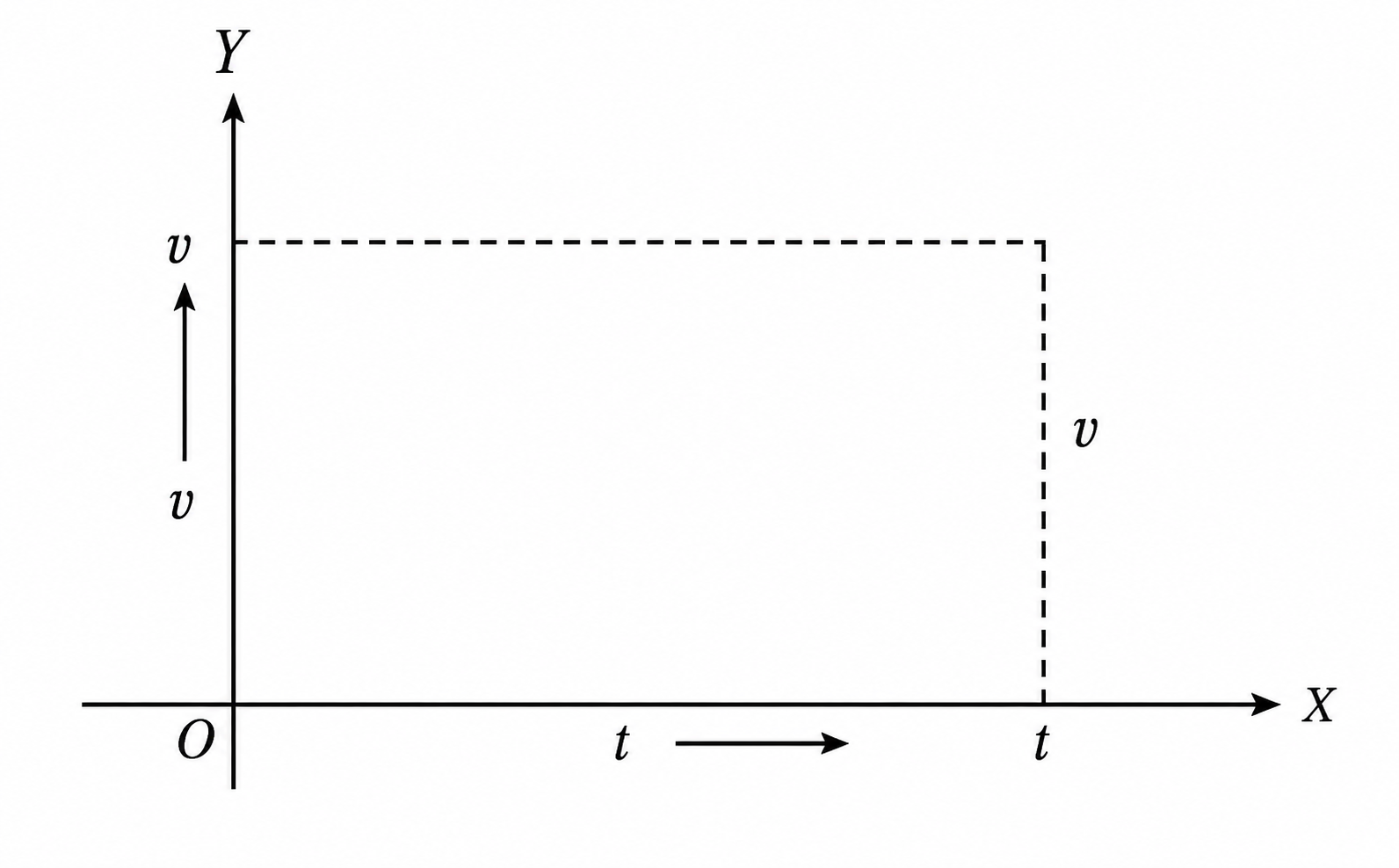
Case 1: Motion with Constant Speed
When an object moves with a constant speed, the speed-time graph is a horizontal line.
Formula:
Geometric Interpretation:
(i).The area under graph forms a rectangle.
(ii). Area of rectangle = Base × Height
(iii). This area is equal to the distance travelled.
Case 2: Motion with Uniform Acceleration
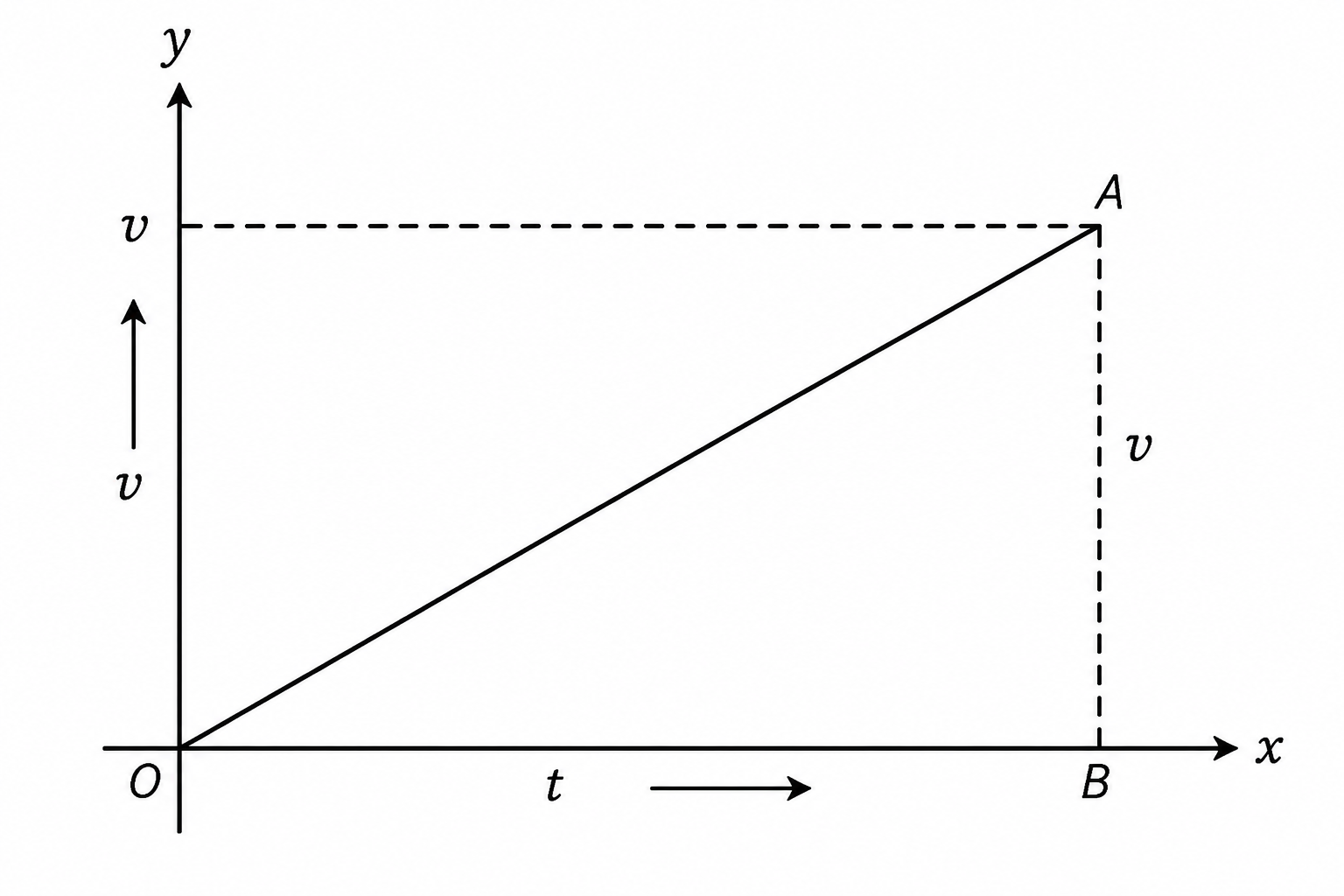
When an object moves with uniform acceleration, its speed-time graph is a straight line sloping upward from O to V.
Formula:
The average speed during motion is:
Vavg =( 0+v)/2 = v/2
Distance Travelled is
Distance = Vavg x t = v/2 x t =( 1/2)v x t
Geometric Interpretation:
The area under the graph forms a right-angled triangle.
Area of Triangle = (1/2)Base x Perpendicular
Area = (1/2)t x v
This area represents the distance travelled.
Application of Equation of Motion under Gravity
1. Equations of Motion Under Gravity:
When solving problems of motion under gravity, the following equations of motion are used:
(i) Final Velocity Equation:
Vf = Vi + at
Where:
Vi = initial velocity
Vf = final velocity
a = acceleration
t = time
(ii) Displacement Equation:
S = Vit + 1/2 at²
Where:
S = the displacement or distance covered.
(iii) Velocity–Displacement Equation:
2aS = Vf² − Vi²
2. Assumptions for Applying These Equations:
(i) Straight Line Motion:
Motion is considered along a straight line, simplifying vector analysis.
ii. Vector Magnitudes:
Only the magnitudes of vector quantities are used for calculations.
iii. Uniform Acceleration:
The acceleration (a) is assumed to be constant throughout the motion.
iv. Sign Convention:
• The direction of initial velocity is taken positive.
• Quantities in the same direction as the initial velocity are positive.
• Quantities opposite to the initial velocity are negative (e.g., gravitational acceleration acting downward if the initial velocity is upward).
3. Conclusion:
These equations and assumptions help solve problems for objects in free fall or projected upward under the influence of gravity. Accurate application of these principles ensures correct results for motion analysis.
Numerical # 1
(a) Solution:
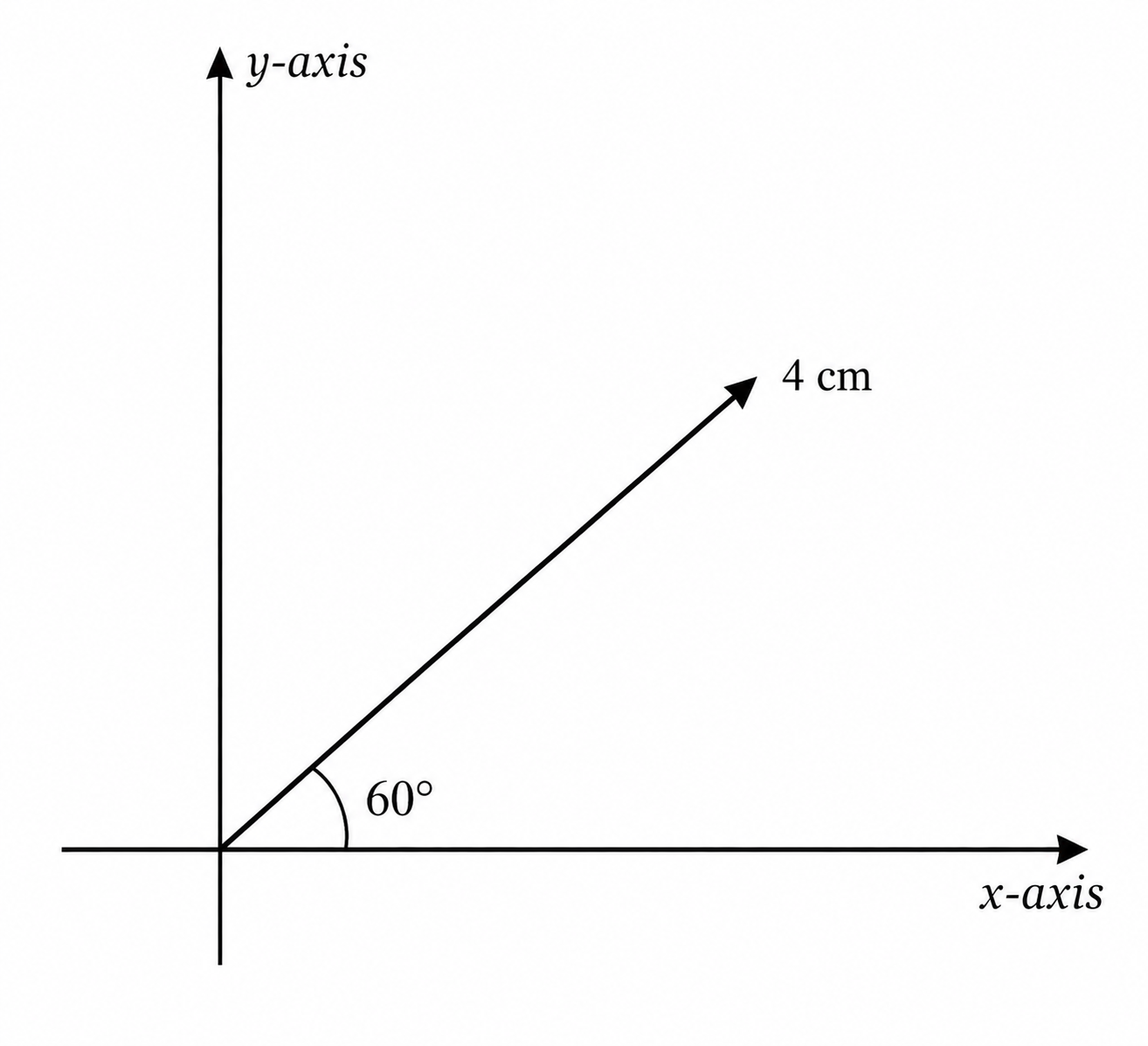
Given data:
V = 400 m s⁻¹
θ = 60°
In scale:
100 m s⁻¹ = 1 cm
So,
400 m s⁻¹ = 4 cm
(b) Solution:
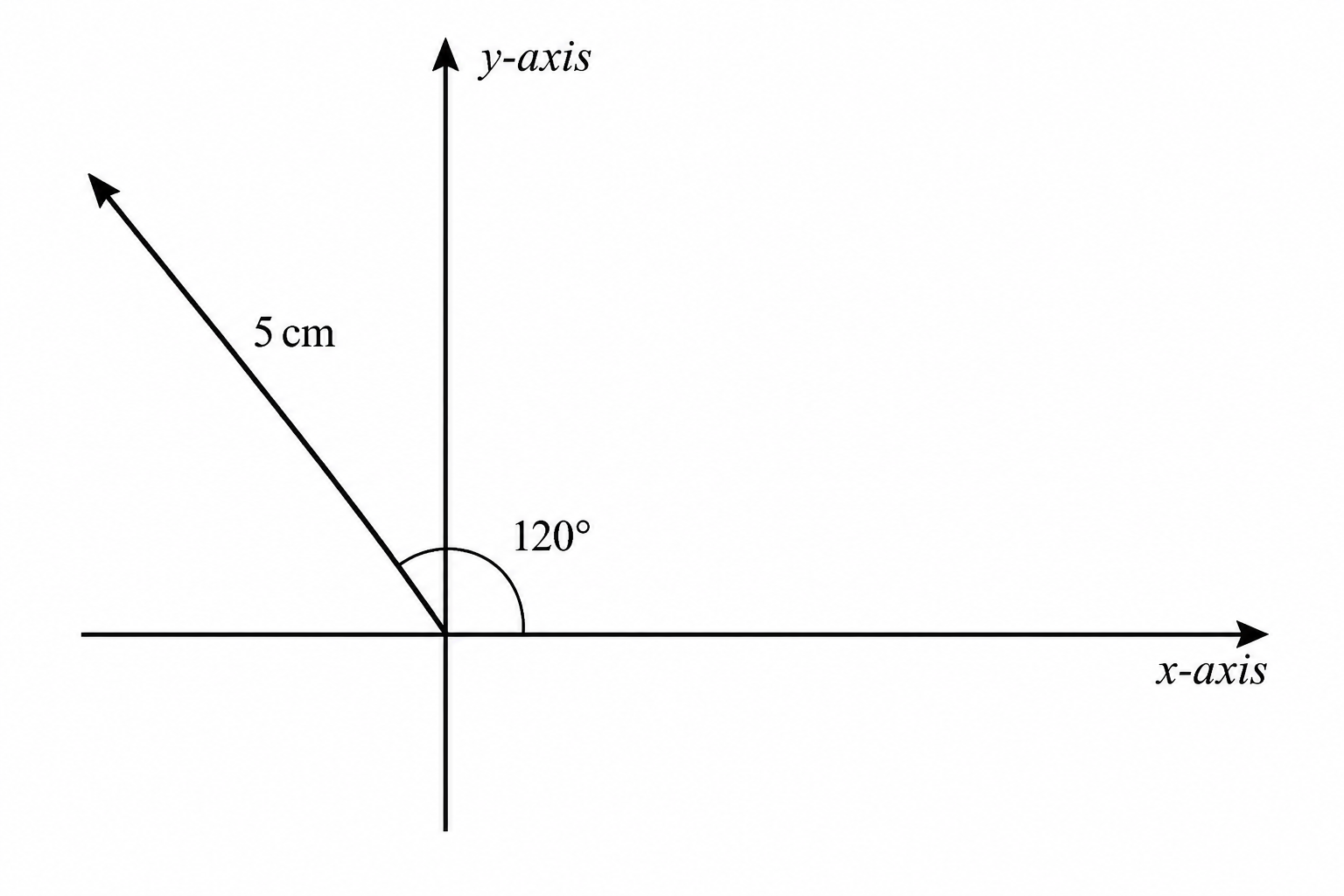
Given data:
Force, F = 50 N
θ = 120°
In scale:
10 N = 1 cm
So,
50 N = 5 cm
Numerical # 2
Given data:
Average speed (v) = 72km/h
Distance (s) = 360km
To Find:
Time (t) = ?
Solution:
Average speed = Total distance covered / Total time taken
Vav =s/t
By putting values
72 = 360/t
t=360/72
t=5hours
Numerical # 3
Given data:
Initial velocity (vi) = 0m/s
Final velocity (vf) = 90km/h : 1km = 1000m
=(90 x1000)/3600 : 1h = 60 x 60
=25m/s = 3600 s
Time (t) = 50s
To find:
Average acceleration (aavg) = ?
Solution:
By using first equation of motion
aavg = (25 - 0)/50
= 25/50
= 0.5 m/s²
Numerical # 4
Given Data:
Initial velocity (vi) = 5ms⁻¹
Acceleration (a) = 1.5ms⁻²
Time (t) = 5s
To find:
Final velocity (vf) = ?
Solution: Using 1st equation of motion
vf = vi + at
By putting values
vf = 5 + (1.5)(5)
vf = 5 + 7.5
vf = 12.5 ms⁻¹
Numerical # 5
Given data:
Initial velocity (vi) = 18kmh⁻¹
= 18 x 1000
3600
= 180
36
= 5ms⁻¹
Acceleration (a) = 2ms⁻²
Time (t) = 10sec
To find:
Distance(s) = ?
Solution:
Using 2nd equation of motion
s = vit + 1/2 at²
By putting values
s = (5)(10) + (1/2)(2)(10)²
s = 50 + 100
s = 150m
Numerical # 6
Given Data:
Initial velocity (vi) = 54kmh⁻¹
= 54 x 1000
60 x 60
= 540
6
= 15ms⁻¹
Final velocity (vf) = 0ms⁻¹
Distance (s) = 25m
To find:
acceleration (a) = ?
Solution:
Using 3rd equation of motion
2as = vf² - vi²
a = vf² - vi²
2s
By putting values
a = (0)² - (15)²
2(25)
a = -225
50
a = -4.5ms⁻²
Numerical # 7
Given Data:
Initial velocity (vi) = 0ms⁻¹
height = s = 45m
g = 10ms⁻²
To find:
vf = ?
t = ?
Solution:
Using 3rd equation of motion
2gs = vf² - vi²
Putting values
2(10)(45) = vf² - 0
900 = vf²
√vf² = √900
vf = 30ms⁻¹
For time we use first equation of motion
vf = vi + gt
vf - vi = gt
(vf - vi)/g = t
by Putting values
30 - 0 = t
10
t = 3s
The stone will take 3s to reach the ground.
Numerical # 8
Given Data :
v = 20ms⁻¹
v₂ = 4ms⁻¹
S₁ = 10km = 10 x 1000 = 10000m
S₂ = 0.8km = 0.8 x 1000 = 800m
average velocity (vav) = ?
average velocity = Total displacement ....eq (1)
Total time
First consider:
t₁ = S₁
V₁
t₁ = 10,000m
20
t₁ = 500sec
Now:
t₂ =S₂/ V₂
t₂ = 800
4
t₂ = 200sec
Total time = t₁ + t₂
= 500 + 200
= 700sec
Now put values in eq. (1)
average velocity = 10,000 + 800
70
= 10,800
70
average velocity = 15.4ms⁻¹
Numerical # 9
Given Data:
Initial velocity (vi) = 0ms⁻¹
Time (t) = 5sec
g = 10ms⁻²
To find:
height = s = ?
vf = ?
Solution:
For vf we use 1st equation of motion
vf = vi + gt
vf = 0 + (10)(5)
vf = 50ms⁻¹
For time we use 2nd equation of motion
S = Vit + 1/2 gt²
Putting values
S = (0)(5) + 1/2 (10)(5)²
S = 0 + 5(25)
S = 0 + 125
S = 125m
So, s = 125m , vf = 50ms⁻¹
Numerical # 10
Given data:
time (t) = 3sec
Vf = 0ms⁻¹
g = -10ms⁻²
To find:
initial velocity (vi) = ?
height = s = ?
Solution:
For initial velocity we use 1st equation of motion
Vf = Vi + at
Vf - gt = Vi
0 - (10)(3) = Vi
0 - (-30) = Vi
0 + 30 = Vi
Vi = 30ms⁻¹
For height we use 2nd equation of motion
S = Vit + (1/2)gt²
S = (30)(3) + (1)(-10)(3)²
2
S = 90 + (-5)(9)
S = 90 - 45
S = 45m
Since the ball was hit 1m so total height becomes
S = 45m + 1m
S = 46m