Chapter 4 - Turning Effect of Forces
Comprehensive Questions & Answers for Class 9 Physics (Punjab Board)
Like and Unlike Parallel Forces
Like Parallel Forces:
Definition:
Forces acting in the same direction along parallel lines.
Example:
For example, in a system where forces F₁ and F₂ act on a rigid body at different points but both in the same direction, they are like parallel forces.
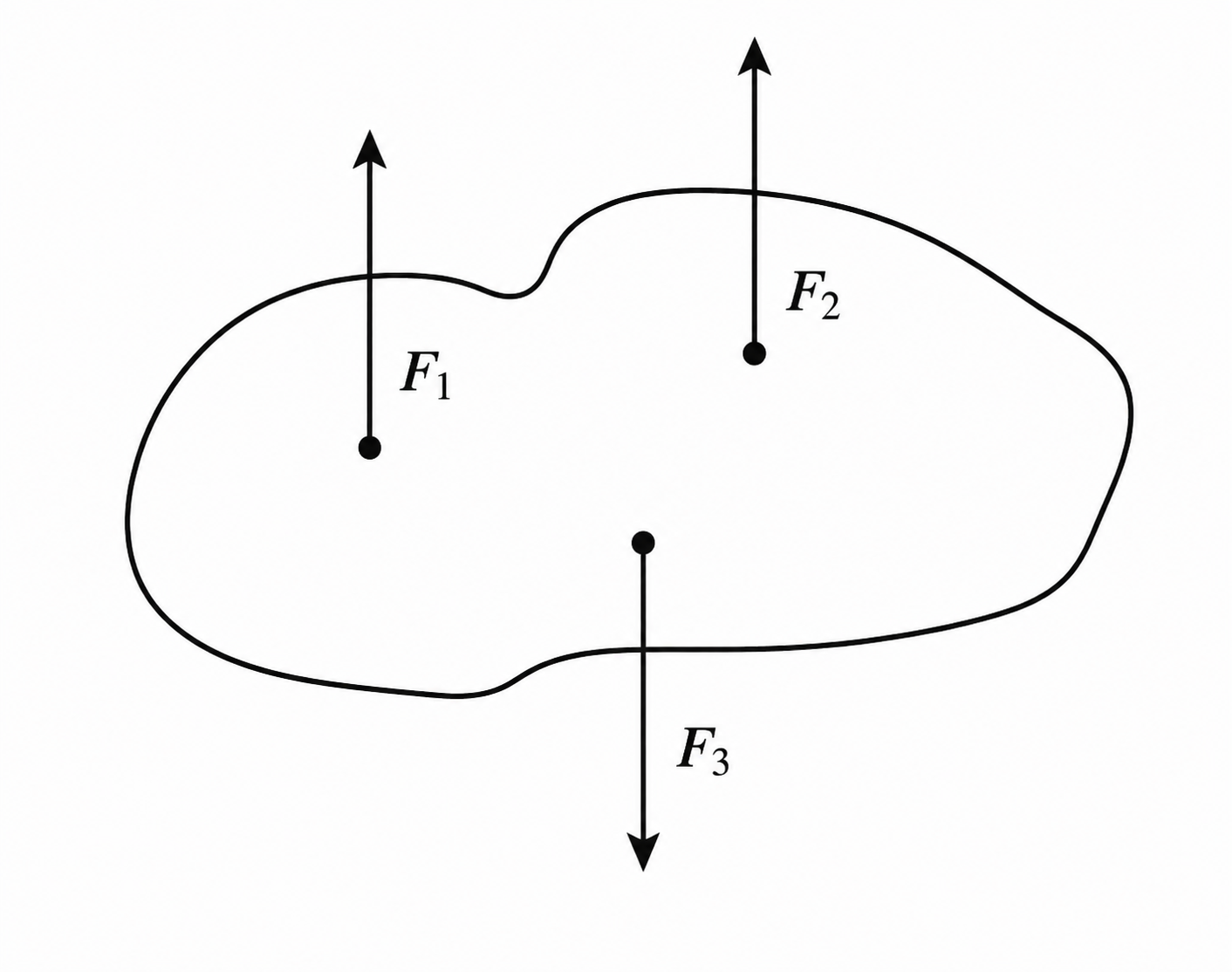
Unlike Parallel Forces:
Definition:
Forces acting in the opposite direction along parallel lines.
Example:
For example, in a system where F₁ and F₃ act on a rigid body at different points but both in the opposite direction, they are unlike parallel forces.
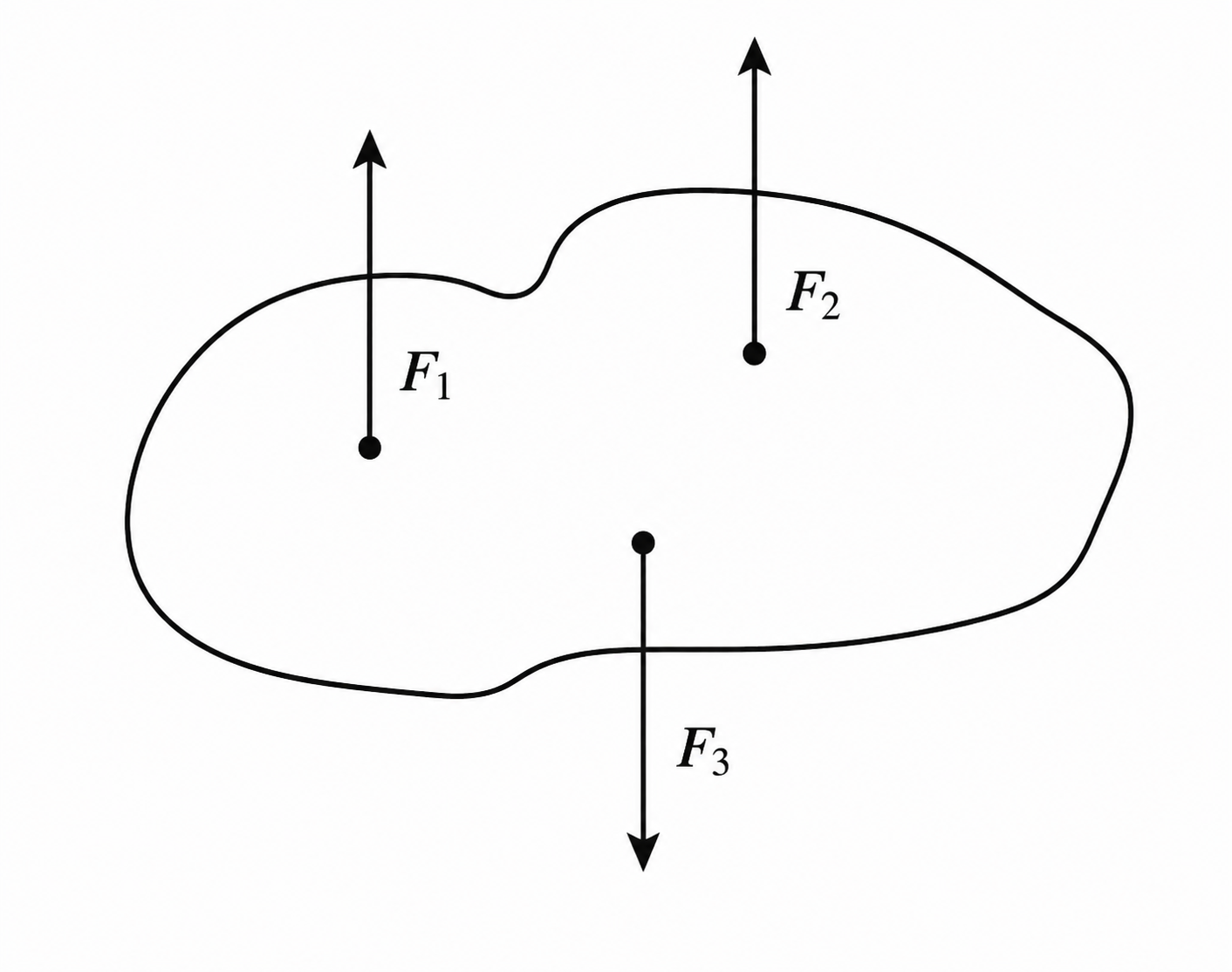
Rectangular Components of Vector
Definition:-
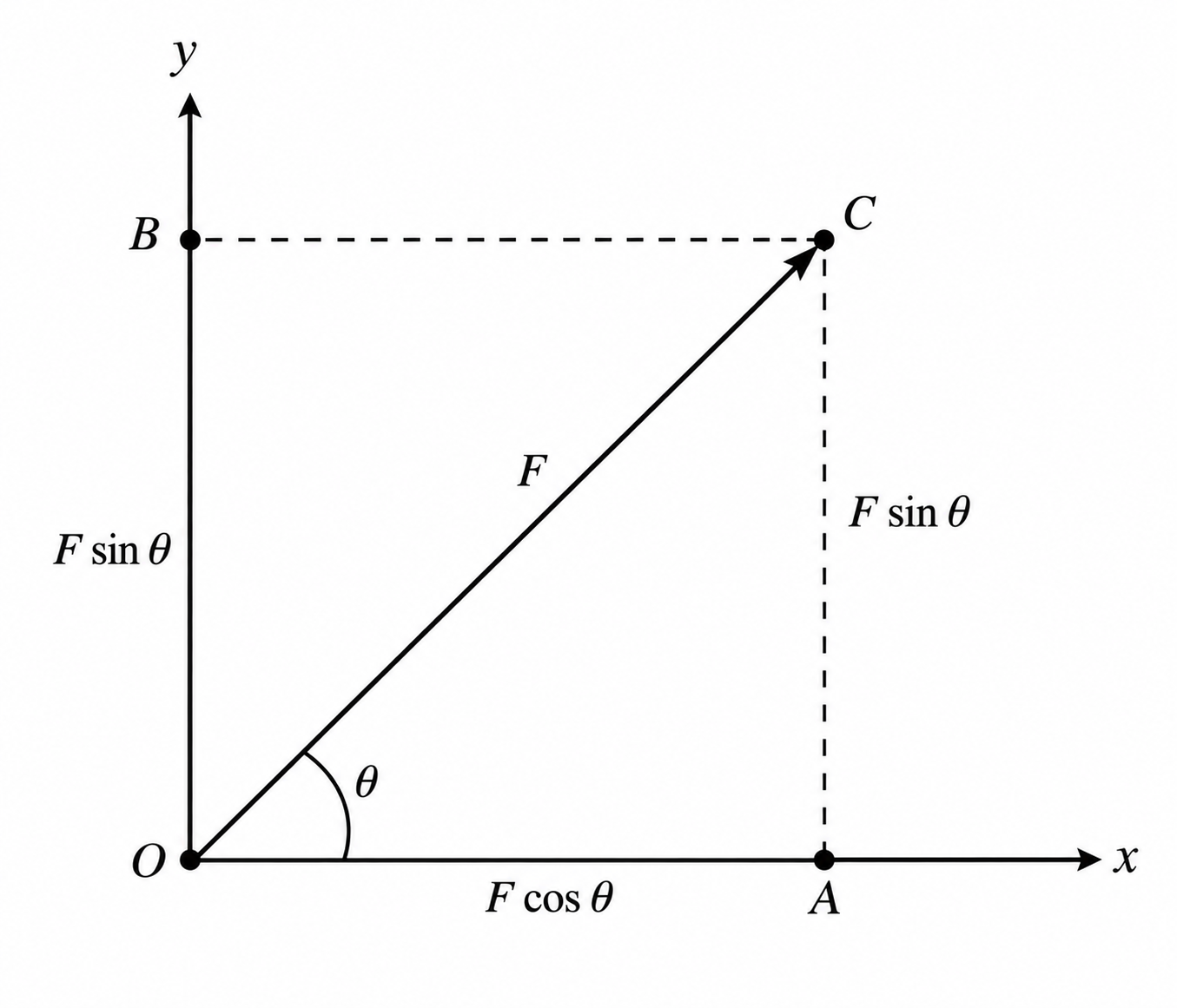
Rectangular Components of a vector are its projections along two perpendicular axes (usually x-axis and y-axis)
OR
A force may be resolved into two or more components which are perpendicular to each other. These are called its perpendicular or rectangular components of the force.
Values:
For a vector F making an angle θ with the x-axis
Fₓ = F cosθ
Fᵧ = F sinθ
Line of Action of Force
Definition:
The line of action of a force is the imaginary straight line extending through the point of application of the force in the direction in which the force acts.
Moment of Force
Definition:-
The moment of a force (torque) is the product of the force and its perpendicular distance from the axis of rotation.
The torque τ is given by
τ = r. F⊥ ∵ ⊥ : Perpendicular
Where, F⊥ = F sinθ is the perpendicular Component of F.
Substituting F⊥:
τ = r . F sinθ
Resultant Force & Resultant Torque
Suppose two Forces F₁ and F₂ are acting on a body at two different points A and B as shown in fig.
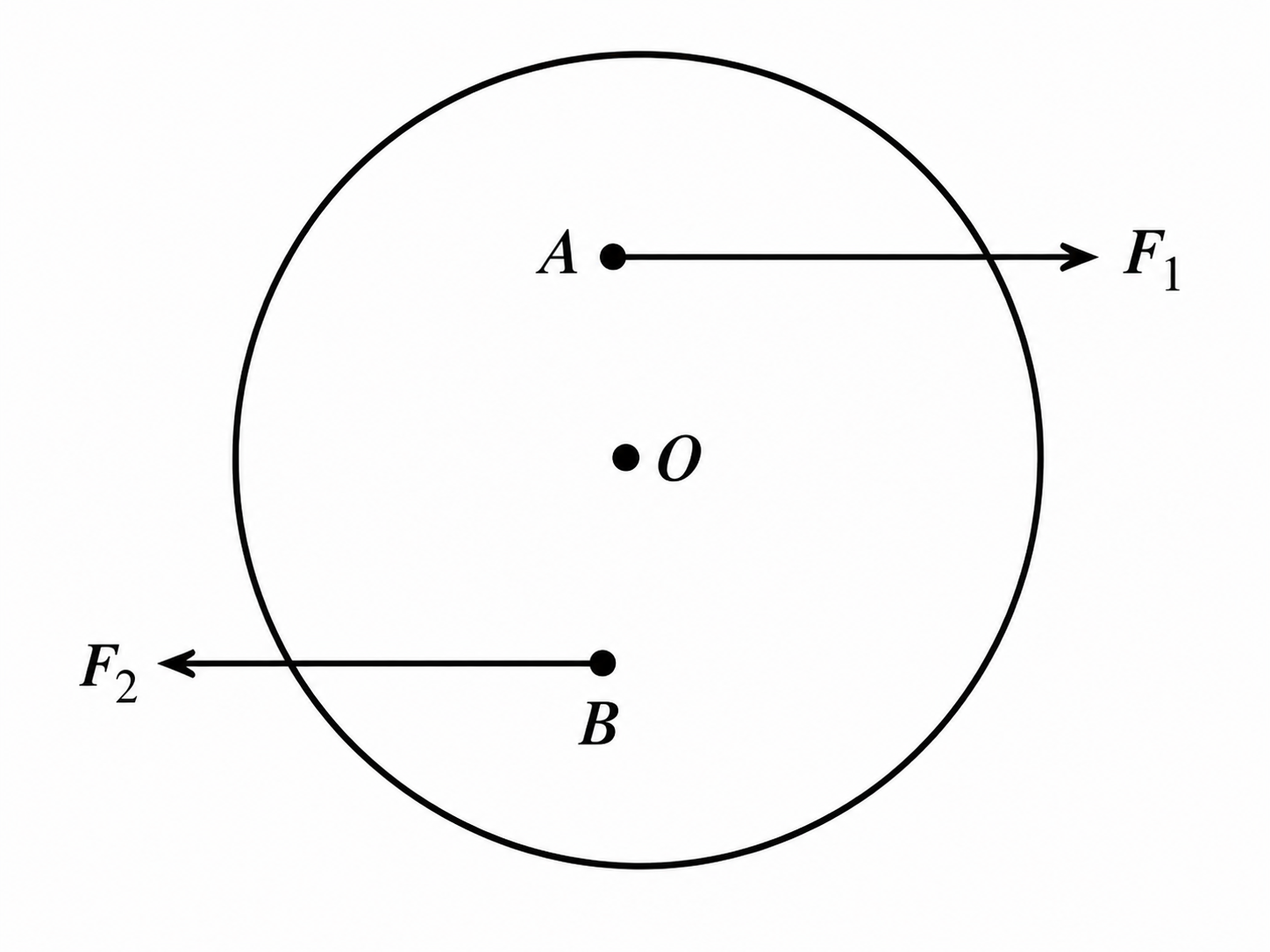
These forces are equal in magnitude but opposite in direction and are not acting along the same line. The resultant of these forces is Zero, i.e.
F₁ + F₂ = 0.
we can see that F₁ is producing a anticlock-wise torque about point O;
τ₁ = F₁ x OA.
Also, F₂ is producing Clockwise torque about point O;
τ₂ = F₂ x OB.
Since both the torque are in the Same sense, they do not balance each other. Therefore, the resultant torque is equal to the sum of these torques and not Zero.
States of Equilibrium
A) Stable Equilibrium
(B) Unstable Equilibrium
(C) Neutral Equilibrium
A) Stable equilibrium:- The Cone returns to its original position when tilted.
B) Unstable equilibrium:- The ball moves further away when tilted.
C) Neutral equilibrium: The cylinder remains at rest in its new position after being displaced.
Equilibrium (Example)
Example:
A car moving at constant speed on a straight road is in dynamic equilibrium because the net force and net acceleration on it are zero.
Centre of Mass & Centre of Gravity
Centre of Mass
Definition:
"The centre of mass of a body is that point where the whole mass of the body is assumed to be concentrated."
Centre of Gravity:
Definition:
"Centre of gravity is that point where total weight of the body appears to be acting."
Principles of stability physics
Following are basic two principles:
1- Lowering the center of gravity increases Stability.
2- Widening the base of support increases Stability.
Centripetal force & Velocity
Proof:
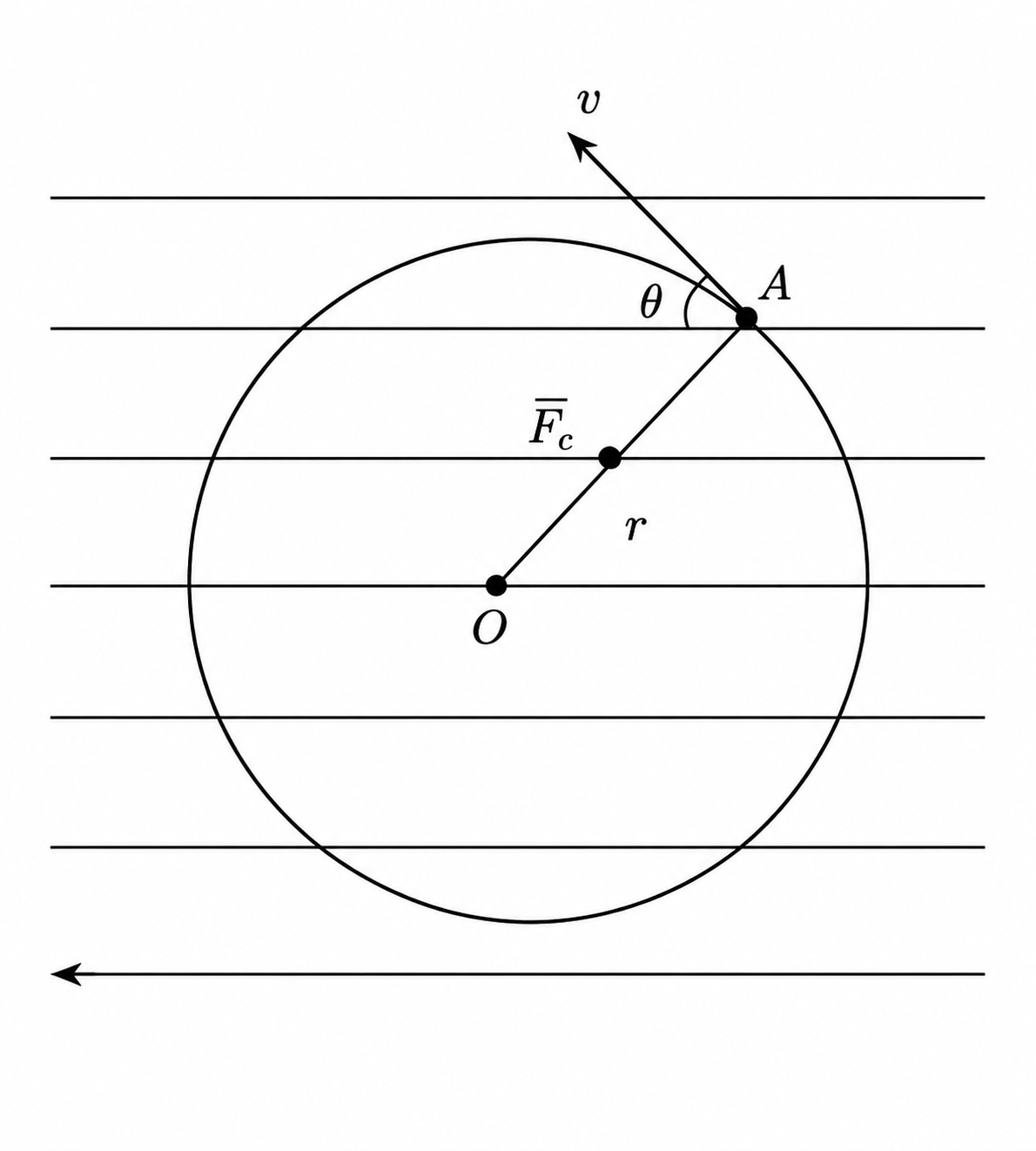
The Centripetal force Fc acts towards the center of the circle.
The Velocity V of the body is tangential to the Circle.
Since, the radius vector (direction of Fc) and
the tangent (direction of V) are always perpendicular to each other, Fc and V are perpendicular.
Centripetal Force And Radius
The Car experiences more centripetal force for the Smaller radius.
Reason:
This is because Centripetal force is given by the formula:
Fc = mv² / r
where; 'm' is mass, 'v' is the velocity, and 'r' is the radius. For a smaller radius, the force is greater, as it is inversely proportional to the radius.
Inertia & Force due to shaking
The shaking of the tree creates a force that momentarily overcomes the force among the branch (Stem or pedical) and ripe mango (fruit) holding the mango. The shaking causes the branch to move, which causes the mango to to lose its stability and fall.
Stability, Centre of Gravity and Base of Support
Stability depends on the position of the Center of gravity and the base of support. If the Center of gravity is higher or outside the base of support, the object becomes less stable, and more likely to topple.
For Example:
A tall, narrow object is less stable than a short, wide object because the center of gravity is higher. Increasing the base of support, like widening the legs of a chair, increases stability.
Equilibrium & Acceleration
An accelerated body cannot be in equilibrium.
"For an object to be in equilibrium, it must be experiencing no acceleration."
In other words because equilibrium requires no net force or torque acting on the body.If the body is accelerating, there is a net force causing that acceleration, violating the first condition of equilibrium (sum of forces is zero).
Center of Gravity and Stability during Sudden Stop
The taller box is more likely to tumble over. This is because it has a higher center of gravity, making it less stable. When the truck stops suddenly, the taller box experiences a greater force that can cause it to topple, as its center of gravity is less aligned with its base.
Energy Transformation
The ball's kinetic energy transfers to the glass, causing it to break. Some energy is lost as sound and heat.
Principle of Moments with Example
Principle of Moments:
The principle of moments states that when a body is in a balanced position, the sum of the clockwise moments about any point equals the sum of the anticlockwise moments about that point.
Mathematically, it can be expressed as:
Total anticlockwise moments = Total clockwise moments
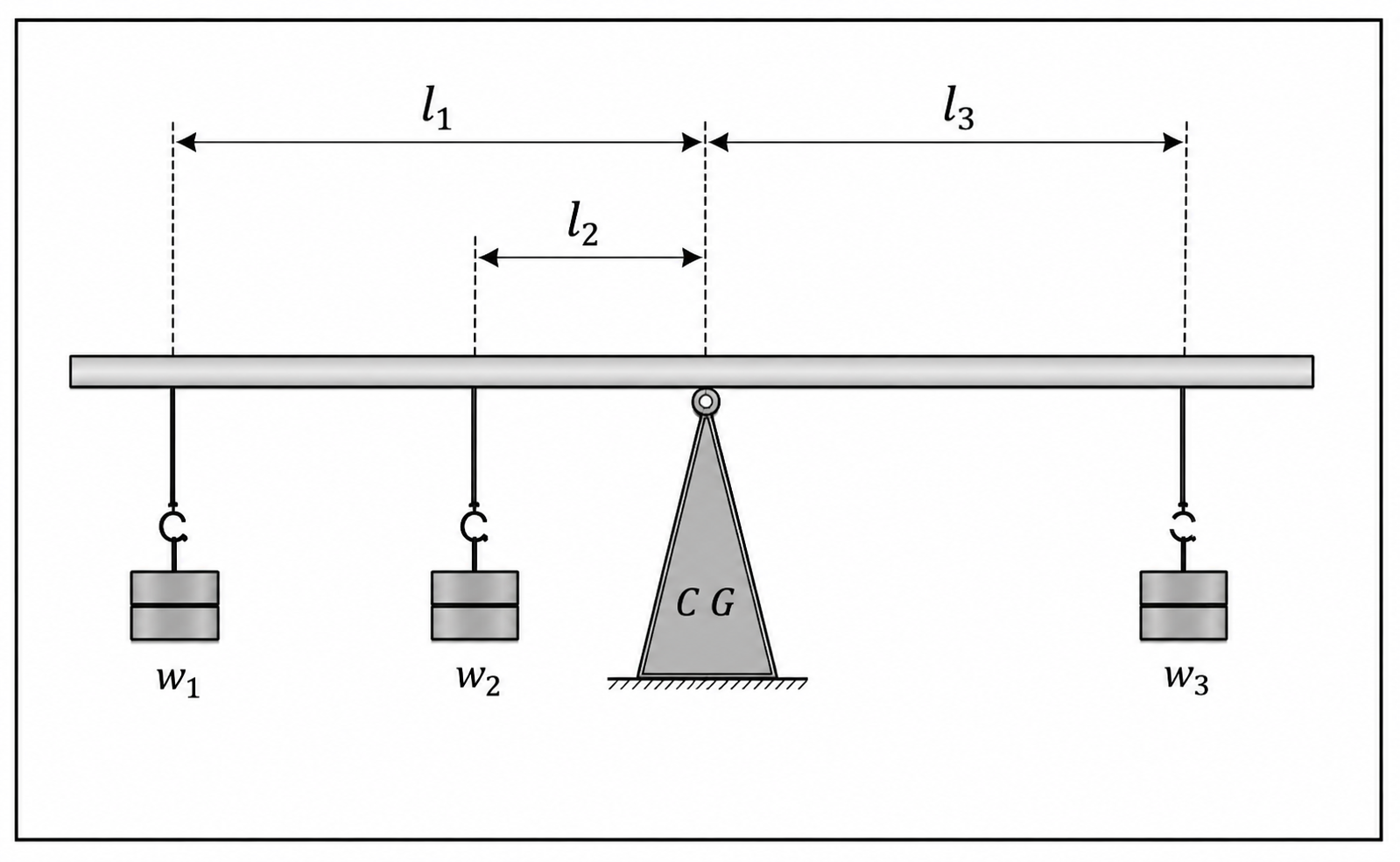
Activity to Demonstrate the Principle:
To understand this principle, perform the following activity:
Balance a metre rule: Place a metre rule on a wedge at its center of gravity (C.G.) so that it stays horizontal.
Suspending weights:
Suspend two weights, w₁ and w₂ on one side of the rule at distances d₁ and d₂ from the center of gravity (C.G.), and suspend a third weight w₃ on the other side at a
distance d₃ until the rule is balanced.
Moment calculations:
The weights w₁ and w₂ tend to rotate the rule anticlockwise about the center of gravity.The weight w₃ tends to rotate it clockwise.
The moments of the weights are calculated as:
Moment of w₁ = w₁ x d₁
Moment of w₂ = w₂ x d₂
Moment of w₃ = w₃ x d₃
Balancing conditions:
When the rule is balanced, the total anticlockwise moments equal the total clockwise moments, satisfying the principle of moments.
Conclusion:
When a body is in equilibrium, the sum of the moments producing an anticlockwise rotation equals the sum of the moments producing a clockwise rotation. This is known as the Principle of Moments.
Experiment to Find Center of Gravity of Irregular Lamina
Centre of gravity
Definition:
The centre of gravity is a point inside or outside the body at which the whole weight of the body is acting.
Centre of gravity of a Plane lamina:
The Centre of Gravity (C.G.) of an irregularly shaped plane lamina can be determined using a simple method of suspension and observation.
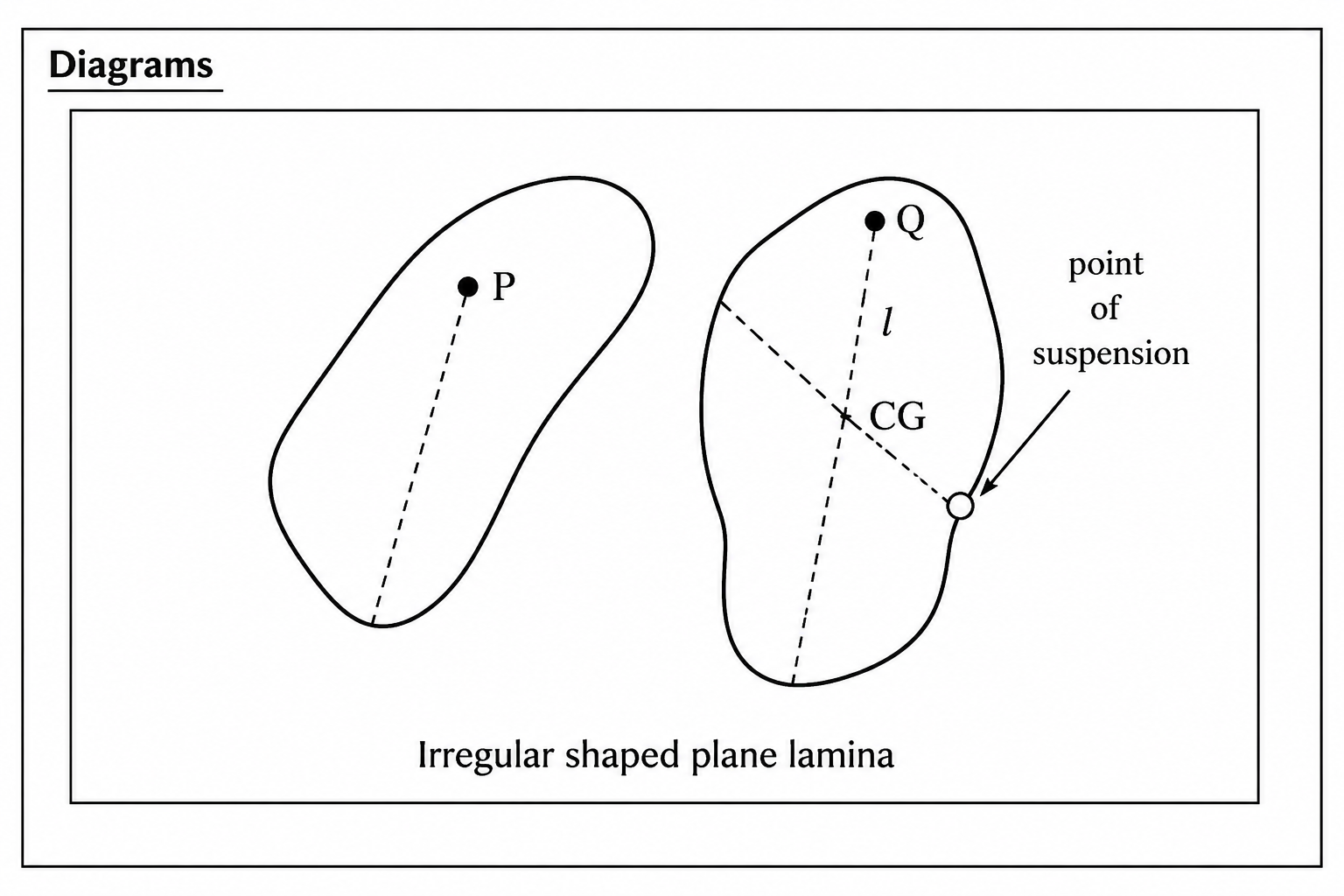
Steps to Find the Centre of Gravity of an Irregular Plane lamina:
1. Suspension at Different Points:
- Suspend the plane lamina freely from different points along its edges.
- Each time the lamina is suspended, its Centre of Gravity lies directly below the point of Suspension.
2. Use of a Plumbline:
- A plumbline (a string with a weight) is used to mark a vertical line from the point of suspension.
- The vertical line indicates the direction where the Centre of Gravity lies.
3. Intersection of Vertical Lines:
- Repeat the suspension from different points of the lamina and draw vertical lines using the plumbline for each suspension.
- The Centre of Gravity of the lamina will be located where two or more vertical lines intersect.
Conditions of Equilibrium
Conditions of Equilibrium:
Equilibrium is achieved when all the forces acting on a body result in no acceleration.
There are two primary conditions for equilibrium:
First Condition of Equilibrium: (Translational Equilibrium)
Second Condition of Equilibrium: (Rotational Equilibrium)
In this response, we will discuss the First Condition of Equilibrium.
First Condition of Equilibrium (Translational Equilibrium):
Statement:
A body is said to be in translational equilibrium only if the vector sum of all the external forces acting on it is equal to zero.
Mathematical form:
According to Newton's second law of motion.
F = ma
If the body is in translational equilibrium,
then a = 0, therefore, net force F should be 0
or
ΣF = 0.
This is the mathematical form of the first condition of equilibrium.
Translational equilibrium implies that there is no acceleration, meaning the body either remains at rest or moves with a constant velocity.
First Condition of Equilibrium in terms of Components:
When several coplanar forces (forces acting on the same plane) are acting on a body, they can be resolved into their rectangular components along the x-axis and y-axis. The first condition of equilibrium can be applied in each direction (x and y) separately.
Along the x-direction:
ΣFₓ = 0
This means that the sum of all the forces acting along the x-axis must equal zero.
Along the y-direction:
ΣFᵧ = 0
This means that the sum of all the forces acting along the y-axis must also equal zero.
In Summary:
First Condition of Equilibrium states that for translational equilibrium, the sum of all forces acting on the body must be zero.
The forces can be resolved into x and y components and each component's sum must be zero:
ΣFₓ = 0 and ΣFᵧ = 0
This ensures that there is no net force causing acceleration in either direction.
2. Second Condition of Equilibrium (Rotational Equilibrium):
Statement:
The vector sum of all the torques acting on a body about any point must be zero.
Explanation:
The Second condition of equilibrium implies to the rotational equilibrium which means that the body should not rotate under the action of the forces.
Consider the example of a rigid body. Two forces F₁ and F₂ of equal magnitude are acting on it.
In case (a), both the forces act along the same line of action.
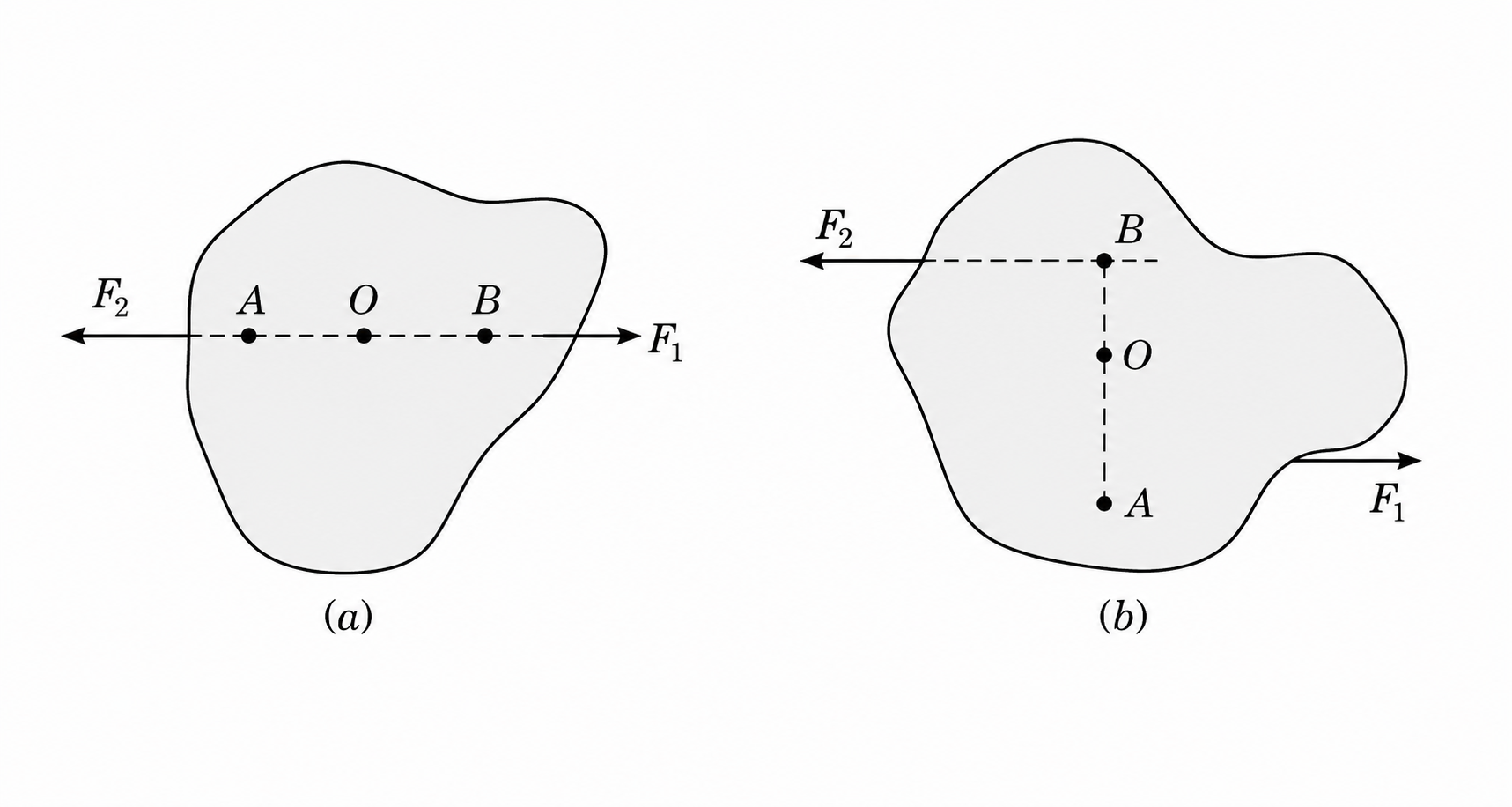
In case (b), the lines of action of two forces are different. Since magnitude of F₁ and F₂ are equal, so the resultant force is zero in both the cases. Thus, first condition
of equilibrium is satisfied. But you can observe that in case (b), the forces are forming a couple which can apply torque to rotate the body about point O.
Therefore, for a body to be completely in equilibrium, a second condition is also required. That is, no net torque should be acting. This is the second condition of equilibrium.
Mathematical form:
Mathematically, we can write:
Στ = 0
Hence, a body will be in complete equilibrium
when,
ΣFₓ = 0
ΣFᵧ = 0
And Στ = 0
Summary:
First Condition of Equilibrium: The sum of all forces acting on the body must be zero (ΣF = 0)
Second Condition of Equilibrium: The sum of all torques (moments) acting on the body must be zero (Στ = 0).
When both conditions are satisfied, the body is in complete equilibrium and will neither translate nor rotate.
Improve Stability of an Object with Examples
Stability:
The ability of an object to maintain its balance and resist toppling over when pushed or moved.
Importance of the Center of Gravity in Stability:
The stability of an object largely depends on the position of its center of gravity (CG).
- Lower Center of Gravity:
A lower CG increases stability, as any disturbance creates a restoring torque that brings the object back to its original position. - Higher Center of Gravity:
A higher CG reduces stability, making the object more likely to topple over when disturbed.
Daily life Examples of Stability:
Low Armchair vs. High Chair:
A low armchair is more stable than a high chair because it has a lower center of gravity.
The lower CG ensures that even when disturbed, the chair resists overturning and quickly stabilizes.
Ships and Boats:
The same principle applies to ships and boats. Lowering the center of gravity by proper loading or increasing the base width improves their stability.
Methods to Improve Stability:
1. Lower the Center of Gravity:
Reducing the height of the center of mass ensures better balance and stability.
For example, loading heavier objects at the bottom of vehicles like buses or ships.
2. Widen the Base:
A wider base increases the area over which the weight is distributed, making it harder to topple the object.
For instance, designing vehicles with wider chassis or using stabilizing fins in ships.
Conclusion:
The stability of a system can be effectively improved by either lowering its center of gravity or increasing its base width. Both techniques help resist disturbances and maintain equilibrium, ensuring the objects doesn't easily topple over.
Example of Stability in Real life:
The concepts of stability plays a crucial role in both engineering and recreational activities. It helps in designing safe and efficient systems while also providing educational value in toys.
Stability in Racing Cars:
Racing cars are engineered to remain stable at high speeds and during sharp turns to prevent them from toppling over
Design Features for Enhanced Stability:
1. Low Center of Gravity:
The center of mass is kept as low as possible to reduce the likelihood of the car tipping over.
2. Wide Base Area:
The wheels are positioned outside the main body to widen the base, improving balance and stability.
These features allow racing cars to handle sharp turns and high-speed driving with minimal risk of accidents caused by instability.
Numerical # 1
Given data:
Force = 200N
Angle = θ = 30°
To Find:
(a) X - Components of force =Fₓ = ?
(b) Y - Components of force = Fᵧ = ?
Solution:
(a) For x-components of force, we use the formula:
Fₓ = F cos θ
Fₓ = 200N x Cos 30°
Fₓ = 200N x 0.866
Fₓ = 173.2 N
(b) For y-components of force, we use the formula:
Fᵧ= F sin θ
Fᵧ= 200N x sin 30°
Fᵧ= 200N x 0.5
Fᵧ = 100N
Numerical # 2
Given data:
Force = F = 300N
Length of knob = l = 1.2m
To Find:
Torque = τ = ?
Solution:
we can use the formula:
τ = F x l
τ = 300N x 1.2m
τ = 360 Nm
Torque produced to open the door is positive.
Numerical # 3
Given data:
Weight of an object = W = 4N
Distance of known weight from C.G = r₁= 40cm
r₁= 40m/100
r₁= 0.4m
Distance of unknown weight from C.G = r₂ = 30cm
r₂ = 30m/100
r₂ = 0.3m
To Find:
Unknown weight of an object = W' = ?
Solution:
As the rod is in equilibrium, so using 2nd Condition of equilibrium
Apply Principle of Moments:
W x r₁ = W' x r₂
W' = (W x r₁) / r₂
W' = (4N x 0.3m) / 1m
W' = 3N
Numerical # 4
Given:
A see-saw is balanced with two children sitting near either end.
1) Child A weighs 30kg and sits 2 meters away from the pivot.
2) Child B weighs 40kg and sits 1.5 meters from the pivot.
To find:
Total moment on each side and determine if the see-saw is in equilibrium.
Solution:
Weight of child A = w₁ = mg
= 30kg x 10m/s²
w₁= 300N
Weight of child B = w₂ = mg
= 40kg x 10m/s²
w₂ = 400N
Moment arm of Child A = r₁ = 2m
Moment arm of Child B = r₂ = 1.5m
Using Principle of moments:
Clockwise moment = Anticlockwise moment
w₁ x r₁ = w₂ x r₂
Moment of child A = w₁ x r₁ = 300N x 2m = 600Nm
Moment of child B = w₂ x r₂ = 400N x 1.5m = 600Nm
Since moment of each side is equal, so see-saw is in equilibrium.
Numerical # 5
Given data:
Downward Force = F₁ = 250N
Distance of weight from O = r₁ = 5cm = 5 m = 0.05m
100
Distance of force = O = r₂ = 30cm = 30 m = 0.3m
100
To Find:
Weight of the other end = F₂ = W = ?
Solution:
Using principle of moment:
F₁ x r₁ = F₂ x r₂
F₁ x r₁ = W x r₂
W = (F₁ x r₁) / r₂
W = (250N x 0.05m) / 0.3m
W = 1500N
Numerical # 6
Given Data:
Length of spanner = l = 30cm
= (30/100)m
= 0.3m
Torque = τ = 150Nm
To Find:
Force = ?
Solution:
We can use the formula;
τ = F x l
or
F = τ/l
F = 150Nm/0.3m
F = 500N
Numerical # 7
Given Data:
weight of ball = w = 5N
Angle = θ = 60°
To Find:
(a) Force = F = ?
(b) Tension = T = ?
Solution:
Using conditioms of equilibrium:
∑Fₓ = 0
∑Fᵧ = 0
(a) Resolving T into verticle components
∑Fᵧ = 0
T sinθ = W
T sin60° = 5N
T (0.866) = 5N
T= 5N/0.866
T = 5.8N
(b) For horizontal components
F = T cosθ
F = 5.8N cos60°
F = 5.8N x 0.5
F = 2.9N
Numerical # 8
Given Data:
Weight of signboard = W = 200N
To Find:
(a) Tension in first steel wire = T₁ = ?
(b) Tension in second steel wire = T₂ = ?
Solution:
Let O be the point where signboard is suspended
using first condition of equilibrium
∑Fₓ = 0 and ∑Fᵧ = 0
For vertical position
T₁ + T₂ - W = 0 ____________(1)
Take B as point of rotation, then taking moment about B.
W x OA = T₁ x AB - T₂ x 0 = 0
200N x 2 - T₁ x A = 0
T₁ = (200N x 2)/4
T₁ = 100N
Again; using equation (1)
T₁ + T₂ - W = 0
T₂= W - T₁
T₂ = 200N - 100N
T₂ = 100N
Numerical # 9
Given data:
Mass of girl = m₁ = 30kg
Weight of girl = w₁ = 30kg x 10m/s = 300N
Mass of Second girl = m₂ = 40kg
Weight of Second girl =w₂ = 40kg x 10m/s² = 400N
To Find:
Distance of Second girl = r = ?
Solution:
Let Second girl at 'r' metre distance from the other girl.
Using law of moments about O:
w₁ x OA = w₂ x r
300N x 1.6 = 400N x r
r = (300N x 1.6) / 400N
r = 1.2m
Numerical # 10
Given data:
Weight of box = W = 150N
To Find:
Tension in string
T₁ = ? and T₂ = ?
Solution:
Resolving T into its Components:
Tsinθ and Tcosθ
Or
T sin 60° and T cos 60°
Using ΣFx = 0 and ΣFy = 0
W - T₁ sin 60° = 0
W = T₁ sin 60°
150 = T₁ (0.866)
T₁ = 150 / 0.866
T₁ = 173.2N
Now,
T₂ = T₁ cos 60°
T₂ = 173.2 x 0.5
T₂ = 86.6N