Chapter 7 - Thermal Properties of Matter
Comprehensive Questions & Answers for Class 9 Physics (Punjab Board)
Fixed Volume and Shape of Solids (Particle Theory)
In Solids, the intermolecular forces are so strong that they keep molecules bound. So molecules are held at fixed positions but still they show vibrational motion about their fixed points. This is why, the solids have a fixed volume and shape.
Gases Have Neither Fixed Volume nor Fixed Shape
i- Gas molecules are relatively far away from one another.
ii- They move freely in random direction, allowing them to expand and take shape and volume of container.
Mercury vs Alcohol as Thermometric Liquid
Mercury is opaque and can be easily seen due to its silvery colour. Alcohol is also a choice for the thermometric liquid, but it must be coloured to make it visible.
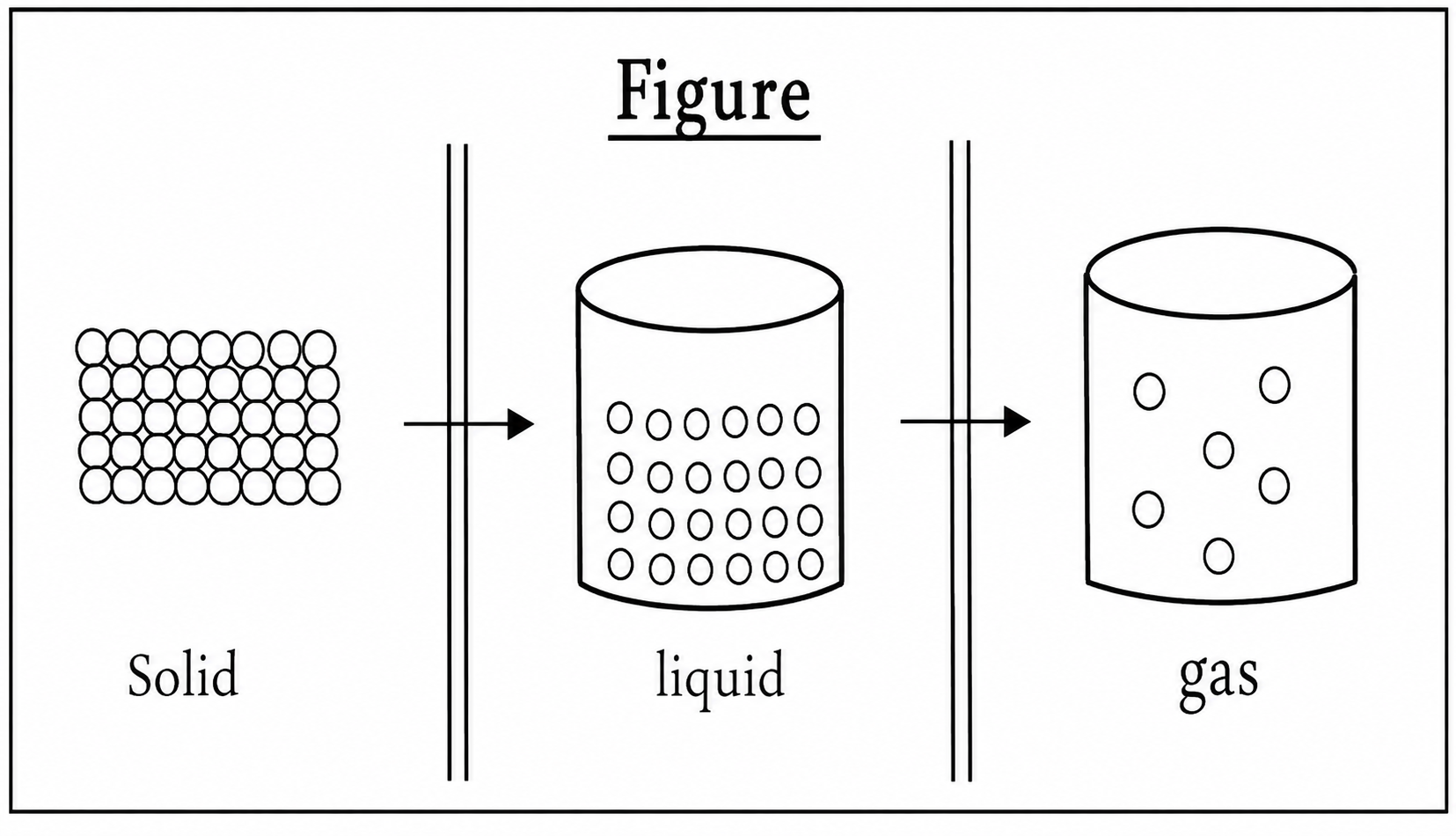
Spacing of Molecules in Solid, Liquid and Gas
- Solid:
Molecules are tightly packed.
- Liquid:
Molecules are less tightly packed but still close.
- Gas:
Molecules are widely spread.
Effect of Raising Temperature of Liquid
Molecules move faster increasing their kinetic energy, which may lead to expansion or change of state to gas.
Definition of Temperature of a Body
Definition:
Temperature of a body is defined as degree of its hotness and coldness.
Example:
i- When we touch ice we feel cold.
ii- When we dip our fingers in warm water, we feel heat.
Heat as 'Energy in Transit'
Heat is energy which is transferred from one object to another due to difference of temperature between two bodies.
Thermometric Property and Properties
1. Thermometric property:
a- Definition:
Thermometers (For the exact measurement of hotness of a substance, we require an instrument called thermometer) use some property of a substance, which changes appreciably with change of temperature.
2. Basic thermometric properties:
a. It is a good conductor of heat.
b. It gives quick response to temperature changes.
c. It has uniform thermal expansion.
d. It has high boiling point.
e. It has low freezing point.
f. It does not wet glass.
g. It is visible.
Main Scales Used for Temperature Measurement
1. Celsius: 0°C to 100°C
2. Fahrenheit: 32°F to 212°F
3. Kelvin: 273K to 373K
Sensitivity of a Thermometer
Sensitivity:
a- Definition:
Sensitivity of a thermometer refers to its ability to detect small changes in temperature of an object.
b- Example:
Minimum division on scale of a thermometer is 1°C. The accuracy of its temperature measurement will be 1°C. On another thermometer the marks are 0.1°C apart. Hence, its accuracy will be up to 0.1°C and said to be more sensitive. Its measurement will be more precise than the measurement of a thermometer with an accuracy of 1°C.
Linearity of a Thermometer
Linearity of a thermometer:
Definition:
Linearity refers to a direct proportional relationship between temperature and scale reading across entire range of measurement.
Factors affecting on accuracy of Scale Reading of Thermometer
i- Calibration
ii- Uniform Expansion
iii- Precise marking
Direction of Heat Flow
Temperature is the physical quantity which determines direction of flow of thermal energy.
Heat vs Internal Energy
Heat:
Heat is the energy which is transferred from one object to another due to difference of temperature between the two bodies.
Internal Energy:
The sum of kinetic and potential energies of molecules of an object is called internal energy.
Heat Transfer When Touching Cold Surface
Energy travels from hand to cold surface as heat flows from high temperature to low temperature.
Feeling Fever by Touching Forehead
No, because both hand and forehead are at same temperature so no heat transfer occurs.
Kinetic Molecular Theory for Plasma State
Yes, it applies. In plasma, particles (ions and electrons) are in constant motion, similar to gases, but interactions include electromagnetic forces.
Water is Not Suitable in Thermometers + Temperature Conversion (Reason)
Because, water has non-linear expansion and a narrow liquid range. 373K is approximately 100°C and 212°F.
Ways to Increase Sensitivity of Liquid-in-Glass Thermometer
i- Use a liquid with high expansivity like alcohol.
ii- Make capillary tube narrower for greater visible movement of liquid.
Temperature Rise of Different Amount of Water on Same Stove
The temperature rise will be 1°C since the heat is distributed over a larger amount of water.
No Negative Numbers on Kelvin Scale (Reason)
Because, Kelvin scale starts at absolute zero, the theoretical minimum temperature, where molecular motion ceases.
Thermometer Measures Its Own Temperature
True, a thermometer reaches thermal equilibrium with the object, so it shows its own temperature equal to the object.
Comparing Temperatures of Different Objects in Winter Night
All objects have nearly same temperature as the air, but metals feel colder due to higher thermal conductivity.
1°C vs 1°F Which is Greater
1°C is greater, as it equals 1.8°F in magnitude.
Molecules in a Gas Don't Have Same Speed (Reason)
Molecules have varying kinetic energies due to random collisions, so their speeds differ.
Temperature of a Vacuum
No, temperature is a measure of average kinetic energy of particles, and a perfect vacuum has no particles.
Hot Body Does Not Contain Heat
True, body contains internal energy. Heat refers to energy transferred between bodies due to temperature differences.
Is Sun Matter?
Yes, Sun is matter, composed mostly of plasma, a state of ionized gas with particles in motion.
Kinetic Molecular Theory and Difference Between States of Matter
1. Kinetic Molecular theory of Matter:
i- Matter is composed of very small particles called molecules which are always in motion. Their motion must be vibrational, rotational or linear.
ii- There exists a mutual force of attraction between molecules known as intermolecular forces.
iii- This force depends upon the distance between molecules. It decreases with increasing distance between them.
2. Difference of three states of matter:
a- Solids:
In solids, intermolecular forces are so strong that they keep molecules bound. So, the molecules are held at fixed positions but still they show vibrational motion about their fixed points. This is why, solids have a definite shape and a definite volume.
b- Liquids:
In liquids, intermolecular force is so weak that it can not hold the molecules at fixed positions and molecules can slide over each other in random directions. A liquid, therefore, possesses a definite volume but has no definite shape. Due to flow of molecules, it acquires the shape of containing vessel.
c- Gas:
Gas molecules are relatively far away from one and another. Due to which, gas neither possess a definite volume nor a definite shape.
Measurement and Construction of Mercury-in-Glass Thermometer (Definition)
1. Temperature:
a- Definition:
Temperature of a body is defined as degree of its hotness or coldness.
2. Measurement:
For the exact measurement of hotness of a substance, we require an instrument called a thermometer.
3. Construction of Mercury-in-Glass thermometer:
We know that liquids expand on heating. So, expansion in volume of a liquid can be used for the measurement of temperature. This is known as liquid-in-glass thermometer. One such liquid which is commonly used in thermometers is mercury. It is made of glass. It has a bulb at one end filled with mercury.
When the temperature rises, mercury expands and moves up through the narrow capillary tube in form of a mercury thread. Position of end of thread reads temperature. Mercury is opaque and can easily be seen dueto its silvery colour. Alcohol is also a choice for thermometric liquid, but it must be coloured to make it visible.
Comparison of Three Temperature Scales
1. Temperature Scales:
a. Celsius or centigrade scale:
In celsius or centigrade scale, the numerical values assigned to lower and upper fixed points are 0 and 100. As the difference between these values is 100, so space between these points is divided into 100 equal parts. Each part is known as 1°C.
b. Fahrenheit Scale:
In Fahrenheit scale, lower fixed point is labelled as 32 and upper as 212. As difference between these two numbers is 180, so in this scale the space between these points is divided into 180 equal parts. Each part is known as 1°F.
c. Kelvin Scale:
In kelvin scale, lower and upper fixed points are labelled as 273 and 373. As the difference between these values is 100, so the width of 1k is same as that of 1°C.
Sensitivity, Range and Linearity of Thermometers
1. Sensitivity
a. Definition:
Sensitivity of a thermometer refers to its ability to detect small changes in the temperature of an object.
b. Example:
The minimum division on the scale of a thermometer is 1°C. The accuracy of its temperature measurement will be 1°C. On another thermometer, the marks are 0.1°C apart. Hence, its accuracy will be up to 0.1°C and it is said to be more sensitive. Its measurements will be more precise than those of a thermometer with an accuracy of 1°C.
2. Range
a. Definition:
Range refers to the span of temperature from low to high over which a thermometer can measure accurately.
b. Example:
A clinical thermometer designed for human body temperature has a narrow or short range, say from 35°C to 42°C. A long-range thermometer is usually used for science experiments in laboratories with markings from −10°C to 110°C.
The choice of liquid for a thermometer puts a lower and upper limit for the range of a thermometer. For example, mercury freezes at −39°C and boils at 357°C. Hence, we can construct mercury-in-glass thermometers within this range.
The marking scale depends upon the desired range of measurement. For extremely low temperatures, alcohol is used. Alcohol has a much lower freezing point, about −112°C, which increases its lower limit for range, but it has a lower upper limit as it boils at 78°C.
3. Linearity
a. Definition:
Linearity refers to a direct proportional relationship between temperature and scale reading across the entire range of measurements.
b. Example:
A good linear thermometer should measure equal increments on the scale corresponding to equal changes in temperature. It means that the markings on the scale should be evenly spaced over the whole range. High linearity means more consistent and proportional scale readings over the entire range to ensure accuracy of measurement.
Improvements in the Structure of Liquid-in-Glass Thermometer
Improvements in parameters of Liquid-in-Glass Thermometer:
a. Linearity Improvement:
A liquid-in-glass thermometer has a narrow and uniform capillary tube having a small bulb filled with mercury or alcohol at its lower end. The thin wall of the glass bulb allows quick conduction through the glass to the liquid from a hot object whose temperature is to be measured.
b. Sensitivity Improvement:
Mercury, being a metal, is a good conductor and hence responds quickly to a change in temperature. The small amount of liquid also responds more quickly to changes in temperature. This quick response makes the device sensitive. The use of mercury is quite suitable for normal measurements. For greater accuracy, alcohol can be used as its expansivity is six times more than mercury, but it has a range limitation to higher temperature measurements due to its low boiling point (78°C).
c. Range Improvement:
The uniformity of the narrow tube or bore ensures even expansion of the liquid required to make a linear measuring scale. The choice of mercury allows it to be used over a long range of temperatures due to its low freezing point and high boiling point. It provides a fairly long range of measurement of temperature.
Numerical # 1
Sol:
1. Conversion from Fahrenheit to Celsius:
a- Formula:
°C = 5/9 x (°F - 32)
b- For 98.6°F:
°C = 5/9 x (98.6 - 32)
= 5/9 x 66.6
= 37°C
2. Conversion from Celsius to Kelvin:
a- Formula:
K = °C + 273.15
b- For 37°C:
K = 37 + 273.15
= 310.15 K
≈ 310 K
So,
98.6°F = 37°C
98.6°F = 310 K
Numerical # 2
Sol:
Let temperature be 'T' where °C and °F are equal.
1. Formula:
°C = 5/9 x (°F - 32)
To find:
T = ?
T = 5/9 x (T - 32)
Solving for T
9T = 5(T - 32)
9T = 5T - 160
9T - 5T = -160
4T = -160
T = -160/4
T = -40
The temperature at which Celsius and Fahrenheit readings are same is -40°.
Numerical # 3
1. Conversion from Fahrenheit to Celsius:
a- Formula:
°C = 5/9 x (°F - 32)
b- For 5°F:
°C = 5/9 x (5 - 32)
= 5/9 x (-27)
= -15°C
2. Conversion from Celsius to Kelvin:
a- Formula:
K = °C + 273.15
b- For -15°C:
K = °C + 273.15
= -15 + 273.15
= 258.15 K
≈ 258 K
So,
5°F = -15°C
5°F = 258 K
Numerical # 4
Solution:
1. Conversion from Celsius to Fahrenheit:
a- Formula:
°F = 9/5 x °C + 32
b- For 25°C
°F = 9/5 x 25 + 32
= 45 + 32
= 77°F
2. Conversion from Celsius to Kelvin:
a- Formula:
K = °C + 273.15
b- For 25°C:
K = 25 + 273.15
= 298.15 K
≈ 298 K
so,
25°C = 77°F
25°C = 298 K
Numerical # 5
To solve this, we need to find temperature in celsius when length of mercury thread is at 67.2mm above ice point.
Given:
Distance between ice point(0°C) and steam point (100°C) is 192mm.
To find:
Temperature = ?
Solution:
We can set up a proportion to find temperature in celsius corresponding to 67.2mm length. Since total length between ice and steam points corresponds to 100°C,
By formula:
Temperature / 100°C = Mercury length / 192mm
Temperature/100 = 67.2/192
Temperature =( 67.2 /192) x 100
Temperature = 35°C
So,
Temperature corresponding to mercury thread at 67.2mm above ice-point is 35°C.
Numerical # 6
We need to find temperature in Fahrenheit when mercury level is 4.5cm above lower mark on a liquid-in-glass thermometer, with total length between fixed points being 20cm.
1. Given:
Length between ice point(0°C) and steam point (100°C) is 20cm.
2. To find:
Temperature = ?
Solution:
Mercury level is 4.5cm above lower mark.
We can set up a proportion to find temperature in Celsius corresponding to 4.5cm length. Since total length between ice and steam points corresponds to 100°C.
By formula:
Temperature(°C) / 100°C = Mercury length / Total length
Putting values:
Temperature / 100 = 4.5 / 20
Temperature = 4.5 x 100 / 20
= 22.5°C
3. Conversion from celsius to Fahrenheit:
a- Formula:
°F = 9/5 x °C + 32
b- for 22.5°C:
°F = 9/5 x 22.5 + 32
= 40.5 + 32
= 72.5°F
Temperature corresponding to mercury level at 4.5cm above ice-point is 72.5°F.