Chapter 3 - Dynamics
Comprehensive Questions & Answers for Class 9 Physics (Punjab Board)
Changes in Motion due to Force
Force:
The agent that changes or tends to change the state of body. A force can produce several types of changes in motion.
• It can start motion of body (if object was initially at rest).
• It can stop moving body (bring it to rest).
• It can change the direction of motion of object (e.g. turning a moving car).
• It can change magnitude of velocity (speeding up or slowing down).
Contact Forces (Examples)
Following are examples of contact forces.
• Friction
e.g. Friction between shoes and floor.
• Tension force
Tension in rope when you pull rope, the force exerted on rope is contact force.
• Normal force
Exerted by a surface. e.g. Normal force on book on the table.
- Air resistance (Drag force)
-
Applied force (Force exerted by person or another object)
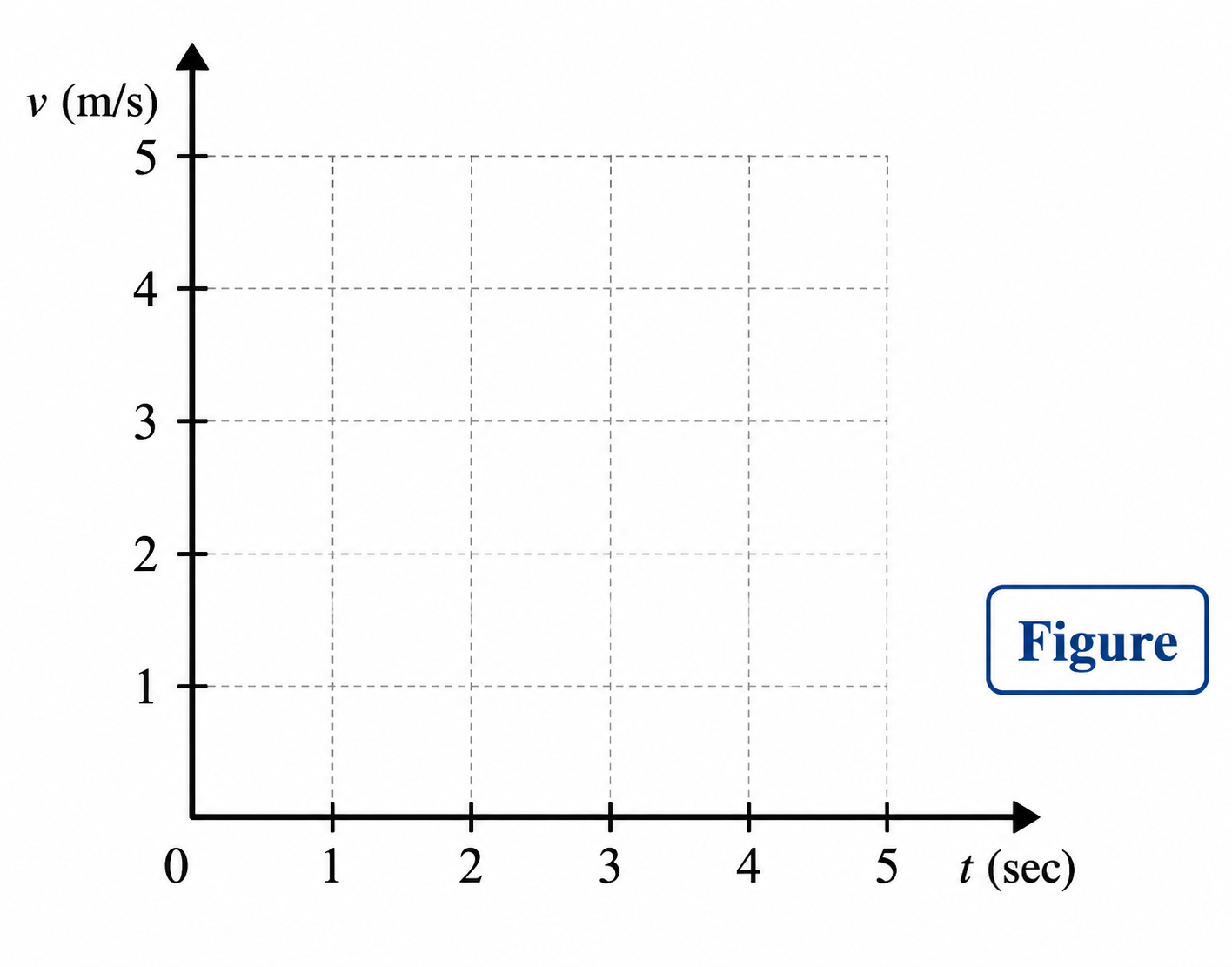
Movement of an object with constant velocity in free space
In free space where there are no external forces acting on the object (like gravity or friction) the object will continue to move with same constant velocity indefinitely. This is according to Newton's first law of motion (Inertia).
Impulse of Force
Definition:
The impulse of a force is the product of the average force and the time interval during which the force acts.
Mathematical:
Impulse = Force x Time
I=Ft ∴ SI Unit = N-s
Impulse is vector quantity. Impulse is also equal to the change in momentum of an object.
Newton's first law on Earth
Reason:
Newton's first law of motion states that:
"A body continues its state of rest or of uniform motion in a straight line unless acted upon by some external force".
So, Newton's first law is not "proved" on earth because there are always external forces like friction, air resistance and gravity acting on objects. On the other hand, In a perfect vacuum or in space, where no external forces act, we could observe the law of inertia more clearly, as object would continue in uniform motion indefinitely.
Example of Law of Inertia
Reason:
"Due to Inertia"
When the car suddenly accelerates, your body tends to remain at rest due to inertia. Since the car moves forward while you resist this motion, it feels like you are pushed back into the seat.
Total External Forces
In Newton's Second Law, the force is referred to as the net force.
Reason:
Because it is the total force resulting from all the individual forces acting on an object. The net force is the vector sum of all external forces, and it determines the object's acceleration.
Rolling vs Sliding Friction
Reason:
To show that rolling friction is less than sliding friction, you can conduct an experiment by comparing the force required to move a wheel (with rolling friction) and a block (with sliding friction) of the same material on a flat surface.
In sliding, the contact area between two surfaces is larger and involves direct contact of the surface asperities, leading to more resistance.
In rolling, only a small contact patch exists, reducing the overall interaction and hence the frictional force.
Hence, The force required to roll the wheel is less than the force required to slide the block, demonstrating that rolling friction is smaller than sliding friction.
Terminal Velocity
Terminal Velocity:
Definition 1:
When upward air resistance balances the downward force of gravity on a falling object, it falls down with constant (safe) velocity, it is called terminal velocity.
Definition 2:
Terminal velocity is the constant speed that a freely falling object eventually reaches when the resistance of the medium (like air resistance) prevents further acceleration. It occurs when the upward force (air resistance) balances the downward force (gravity).
Example:
If we drop a Cricket ball and a piece of Styrofoam with the same weight from the same height, in the absence of air resistance, they would hit the ground simultaneously. However, because the Styrofoam has a larger surface area, it experiences more air resistance, which causes it to fall more slowly than the cricket ball.
Reaction Force for Movement in Space
The astronaut should fire the rocket in the opposite direction to the spaceship.
Reason:
According to Newton's third law of motion, firing the rocket creates a reaction force that pushes the astronaut in the opposite direction, allowing him to move towards the spaceship.
Dynamics (Definition)
Definition:
The branch of Physics which is concerned with the forces that produce change in motion of bodies.
Newton's Third Law - Equal and Opposite Forces
According to Newton's third law, for every action, there is an equal and opposite reaction.
When the two skaters push off from each other, the 60kg skater applies a force on the 80 kg skater, and the 80 kg skater applies an equal and opposite force on the 60 kg skater.
This causes both skaters to move in opposite directions. The 60 kg skater gains a velocity of 4m/s, while the 80kg skater moves with a smaller velocity due to having a larger mass.
Airbags Reduce Force by Increasing Time
Reason:
Airbags help reduce the force experienced during a collision by increasing the time over which the change in momentum (deceleration) occurs.According to the Impulse-momentum theorem, increasing the time over which momentum changes reduces the force, making air bags more effective than seatbelts at reducing injury in a crash.
Action-Reaction Pairs Act on Different Bodies
The horse's reasoning is incorrect
Reason:
Because Newton's third law refers to the forces between two objects. The horse applies a force on the cart, and the cart applies an equal and opposite force on the horse. However, the horse can still move the cart if the force it applies exceeds the friction between the cart and the ground. The cart does not exert a force on the horse that cancels out the horse's ability to move the cart; the horse's net force is what determines its acceleration.
Reduce Force by Increasing Time
Reason:
The fielder draws his hands backward to increase the time over which the momentum of the ball is reduced. By increasing the time, the force exerted on the hands is decreased, reducing the risk of injury and allowing a smoother catch.
Newton's Third Law on Unstable Surface
When the jumper pushes off the boat, he exerts a force on the boat, causing it to move in the opposite direction. According to Newton's third law, the boat exerts an equal and opposite force on the jumper.
However, since the boat is small and has little mass compared to the jumper, the boat moves significantly, causing the jumper to lose his balance and often fall into the water.
Effects of Zero Friction in Daily Life
If friction vanished suddenly, daily activities like walking, driving, or even sitting would become impossible. Without friction, there would be no grip, and people and objects would slide uncontrollably. Cars would not be able to stop or turn. Objects would slide off surfaces, and walking would be like slipping on ice.
Concept of Force ( Daily Life Examples)
FORCE:
Definition:
"The agent that changes or tends to change the State of a body."
(i) Force is commonly understood as a push or pull that starts, stops, or changes the speed or direction of an object's velocity.
(ii) It can either make an object move, stop, or change its motion.
PRACTICAL EXAMPLES OF FORCE:
Examples of force in Daily Life:
(i) Opening a Door: Applying a force to push or pull the door.
(ii) Turning in a Car: While sitting in a car, we push against the seat as the car turns around a corner.Force and Energy Transfer:(i) Force is responsible for transferring energy to an object.
(ii) For instance, a man pushing a wheelbarrow applies force to lift it and then to push it.
(iii). When turning the wheelbarrow around a corner, the man applies different amounts of force on each handle to prevent it from tipping over.
Force acting on Us.
GRAVITY:
A force pulling us downward.
FRICTION:
A force helping us walk on the ground by preventing slipping.Other forces also affect us daily, such as air resistance or the force we apply while lifting objects.
NEWTON'S 1st LAW OF MOTION
NEWTON'S 1st LAW OF MOTION:
Statement:
"A body continues its state of rest or of uniform motion in a straight line unless acted upon by some external force."This law explains that objects do not change their state (whether at rest or in motion) unless a force is applied.
1. Examples of Newton's First Law:
Book on a Table:
A book placed on a table stays at rest until a force is applied to move it.
Ball Rolling on the floor:
A ball will continue rolling indefinitely if no force (like friction) is acting on it, but in reality, it stops due to friction.
2. FRICTION and REAL-WORLD APPLICATIONS:
In real-life scenarios like a bus moving on the road, the bus does not continue moving indefinitely even if the engine stops, because friction between the tires and the road brings it to rest.In outer space, where friction is absent, an object thrown would continue moving at a constant velocity indefinitely.
Definition of Force:
According to the Newton's first law, Force is an agency that changes or tends to change the state of rest or of uniform motion of a body.
Relation of Inertia to Newton's 1st Law:
This law also known as the Law of Inertia because it describes how objects maintain their state of motion or rest unless acted upon by an external force.
NEWTON'S SECOND LAW OF MOTION:
Statement:
If a net external force acts upon a body, it accelerates the body in the direction of force. The magnitude of acceleration is directly proportional to the magnitude of force and is inversely proportional to the mass of the body.
Mathematical Form:
Let
a∝F
a∝1/m
a=(Constant)F/m
F = net external force (in Newton, N)
m = mass of the Body (in kg)
a = acceleration produced (in meters per second square, m/s²)
According to SI Units, if m = 1 kg, a = 1 m/s², F = 1 N, then the value of the Constant will be 1. Therefore, the above equation can be written as:
i) The relationship is expressed as:
a=1×F/m
or
F=ma →(1)
ii) This equation enables the calculation of force, mass or acceleration if any two quantities are known.
Explanation of Proportionality:
Acceleration (a) is directly proportional to Force, If the force increases, the acceleration also increases, provided the mass is constant.
Acceleration (a) is inversely proportional to mass:
For the same force, a heavier object (larger mass) experiences less acceleration compared to a lighter object.
SI Unit of Force
The SI Unit of Force is Newton (N).
Definition:
One newton is defined as the force required to produce an acceleration of 1m/s2 in a body with a mass of 1kg.
1N=1kgm/s²,
SIGNIFICANCE:
The Second law concept connects the cause of motion (force) to the effect of motion (acceleration).
Newton's Second Law in Terms of Momentum
MOMENTUM:
"The momentum of a moving body is the product of its mass and velocity."
Therefore,
P=m×v
Explanation:
Newton's Second Law in Terms of Momentum:
Newton's Second Law of motion, in its traditional form, states that "the force acting on an object is equal to the rate of change of its velocity (or a)".
In terms of momentum, this law can be rewritten as;
As we know that:
F=ma
F=m×Δv/Δt ∴a=Δv/Δt
Momentum is P=m×v
So, above eq; becomes
F=ΔP/Δt →(A)
where
F is the force acting on the object.
ΔP is the Change in momentum
Δt is the time interval.
Implication of the law:
This equation (A) Shows that the force acting on an object is equal to the rate at which its momentum changes. If the momentum of an object is increasing, the object is experiencing a force in the direction of that change.
Similarly, if the momentum is decreasing the object is experiencing a force in the opposite direction.
PRINCIPLE OF CONSERVATION OF MOMENTUM
Before moving toward Principle of Conservation of momentum we have to know what is momentum? So,
Definition of Momentum:
Momentum is the quantity of motion an object possesses. It is the product of an object'smass and its velocity.
P=m×v
PRINCIPLE OF CONSERVATION OF MOMENTUM:
Statement:
If no external force acts on a System of Objects, the total momentumof the system remains Constant before and after any collision or interaction.
In other words;
The total momentum of an isolated system (one not affected by external forces) is conserved.
EXPLANATION:
Consider a isolated system of two Spheres of masses m1 and m2.
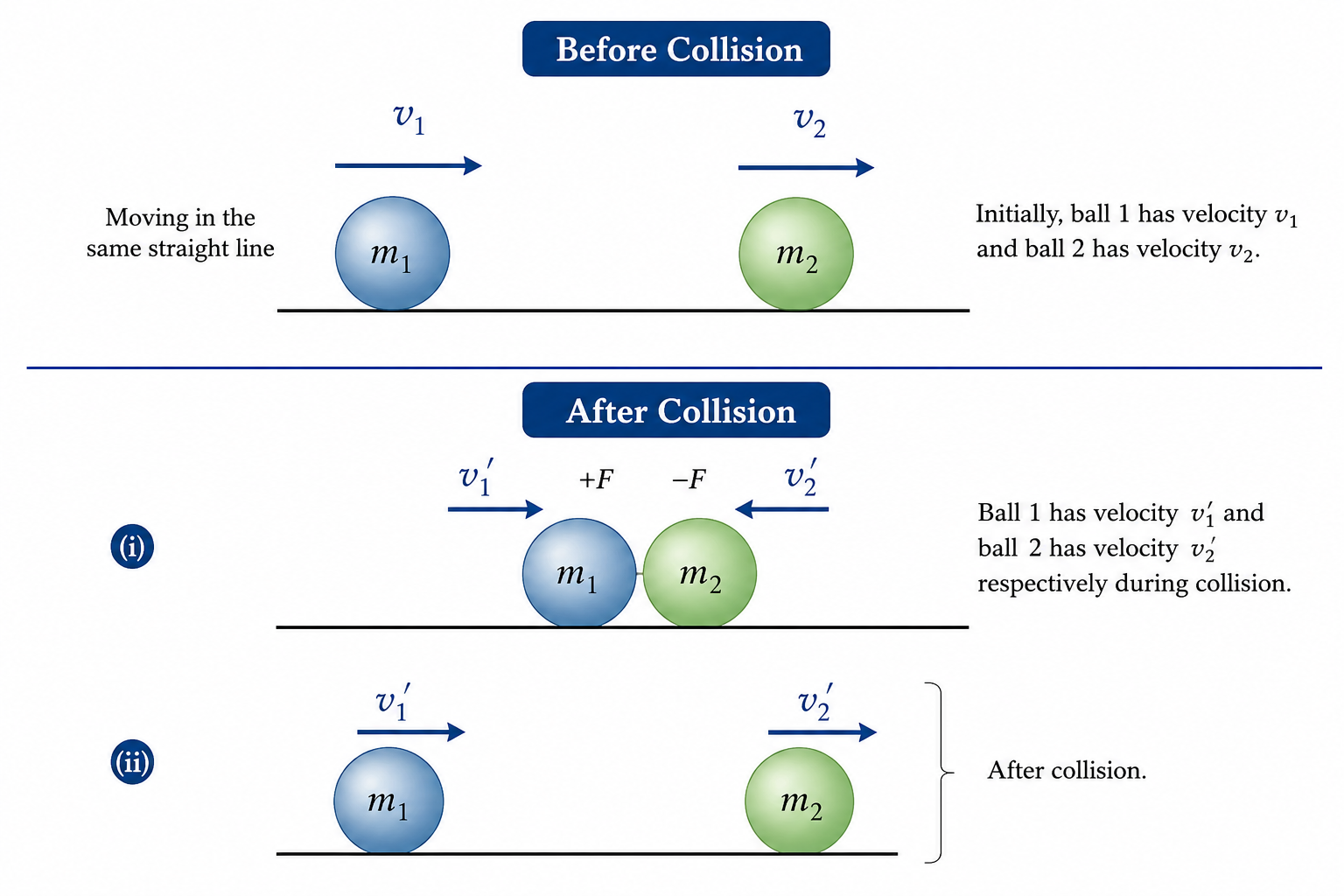
Mathematically:
Initial Momentum of mass m1 = P1 = m1V1
Initial Momentum of mass m2 = P2 = m2V2
Total Initial momentum = m1V1+m2V2
Final Momentum of mass m1 = P1′ = m1V1′
Final Momentum of mass m2 = P2′ = m2V2′
Total final momentum = m1V1′+m2V2′
Mathematically overall principle is expressed as:
Total momentum before Collision = Total momentum after collision
m1V1+m2V2=m1V1′+m2V2′
i) The law is based on the idea that momentum can be transferred between objects in a system during collisions but cannot be created or destroyed in an isolated system.
ii) For a system where no external forces are acting, the total momentum remains unchanged before and after the collision, meaning the momentum is conserved.
Static and Kinetic Friction
Motion of a block on a table:
To describe the motion of a block on a table and taking into account the friction b/w the two surfaces. Let us consider the motion of a block on a horizontal surface.The arrangement is as shown in Fig.
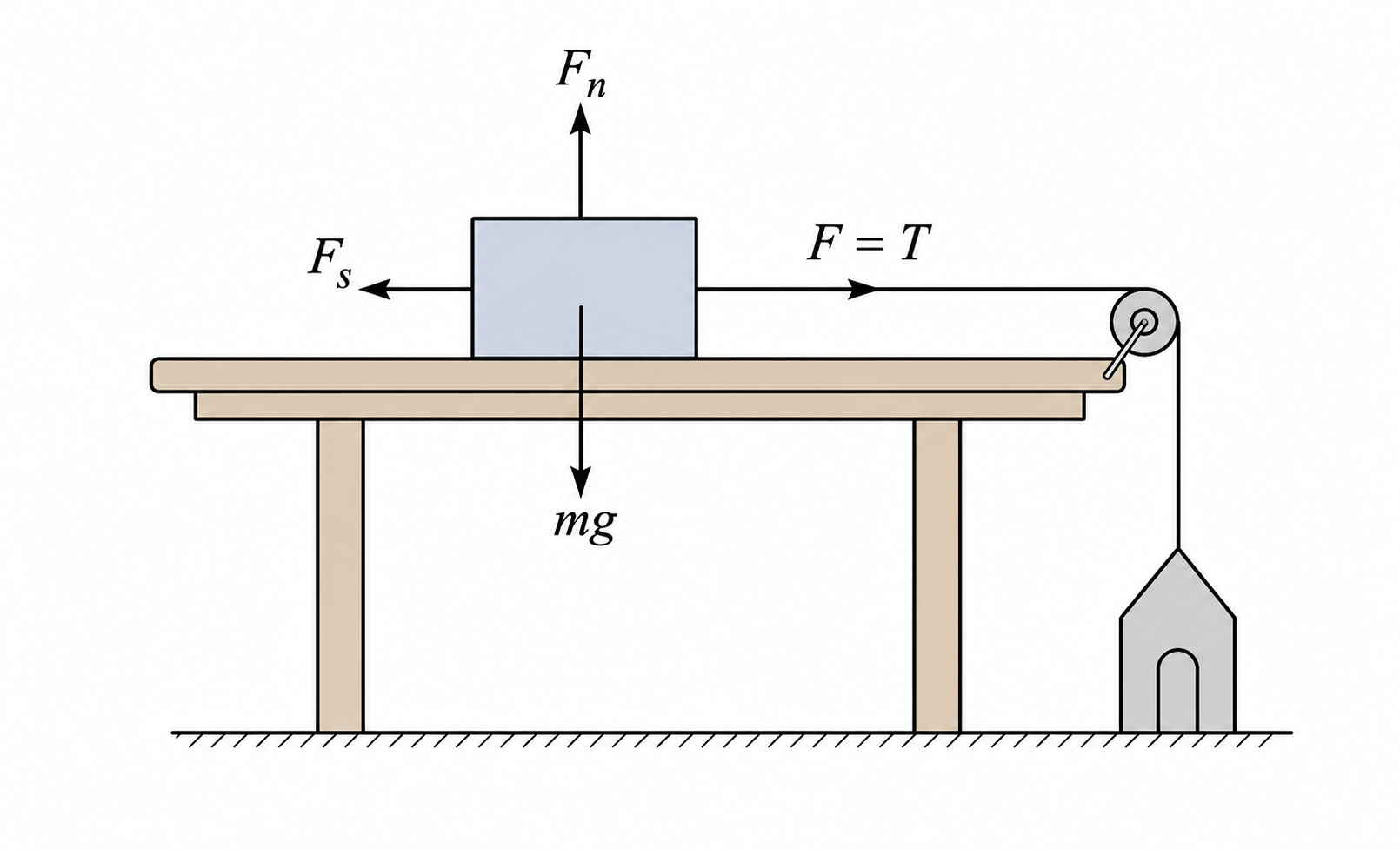
When a weight is put in the pan, a force F = T equal to the sum of this weight and weight of the pan acts on the block. This force tends to pull the block. At the same time an opposing force appears that does not let the block move.
→ Initially, static friction (denoted as Fs) will resist the motion and keep the block stationary.
→ As the applied force increases, the Static friction, increases until it reaches its maximum value.
This opposing force is the static friction Fs.
Now,
If we go on adding more weights in the pan one by one in small steps, a stage will come when the block starts Sliding on the horizontal surface. This is the limit of static friction that is equal to the total weights including pan. After describing the motion of a block on a Horizontal Surface we have, friction b/w two Solid Surfaces
is called Sliding friction which can be divided into two Categories:
Static friction and kinetic friction
Static friction:
Static friction is the force that resist the initiation of motion between two objects at rest".
Kinetic Friction:
"Kinetic Friction occurs once the object starts sliding over the surface".
→ After the static friction is overcome, the blocks begins to slide, and the opposing force is now kinetic friction.
→ Generally it is less than static friction, meaning once an object starts moving, it's easier to keep it in motion.
Effect of Friction on the Motion of Vehicle
Friction:
Friction is a force that opposes the motion of an object. When a moving object comes into contact with another surface, friction acts in the opposite direction of motion, slowing down and eventually stopping the object.
Vehicle tyres:
Friction b/w tyres and the road causes the tyres to wear out over time due to the heat generated.
Different factors affect friction.
The required two are following;
Tyre Surface:
If the surface of the tyre is smooth, there would be less friction, as a rough surface always increases friction. Usually old and worn out tyres have smooth surface; which results in a longer distance covered when applying the brakes. Furthermore, if there are treads or tracks on the tyre surface, there would be more friction.
The Braking force:
The braking force i.e, friction b/w tyre and brake is unaffected by road condition or tyre surface. Hence the distance the vehicle travels while retarding due to "braking force", is not same as stopping distance, because even when the wheels are stopped rotating due to braking force, the car will skid a little distance this total distance is the stopping distance.
Numerical # 1
Solution:
Given data:
Mass = m = 10kg
Force = F = 5N
To find:
(a) Acceleration = a = ?
(b) Velocity of block = v = ?
(a) To find acceleration produced in the block:
we can use Newton's Second law of Motion,which states that:
F=ma
=> a=F/m −>(1)
Putting the values in eq (1)
a=5N/10kg
a=0.5Nkg⁻¹.
As 1N = 1kg m/s². therefore;
a=0.5kgm/s².kg⁻¹.
a=0.5m/s².
(b) To find the velocity of the block after 5 seconds.
we can use the equation of motion for velocity i.e.
Vf=Vi+at →(2)
putting values in above equation (2)
Vf=0m s⁻¹+0.5m/s²×5s
Vf=2.5m/s².s
Vf=2.5m s⁻¹
Numerical # 2
Given data:
Mass of the person, m = 80kg
Acceleration due to gravity on Earth, gₑ=9.8m/s²
Acceleration due to gravity on Moon, gₘ=1.6m/s².
To Find:
(a) Weight of a person on the Earth Wₑ = ?
(b) Weight of a person on Moon = Wₘ = ?
Solution:(a)
To find weight on Earth and on Moon we use:
W=mg
where,
W is the weight
m is the mass of the person
g is the acceleration due to gravity
(a) Weight on Earth:
Using the formula for weaight on earth
Wₑ=m×gₑ
Wₑ=80×9.8(kg.m/s²)
Wₑ=784N
(b) Weight on the Moon:
Using the formula for weight on Moon:
Wₘ=m×gₘ
Wₘ=80×1.6(kgm/s²)
Wₘ=128N
So,The weight of the person on the Moon is 128 N and on earth is 784 N.
Numerical # 3
Given Data:
Mass of the car, m = 800kg
Initial velocity, Vi = 10 m/s
Final Velocity, Vf = 30 m/s
Time, t = 10 sec
To Find:
F = ?
Solution:
By using formula;
Vf = Vi + at
we have to calculate acceleration, so from above eq:
a = (Vf - Vi) / t
a = (30 - 10) / 10
= 20 / 10
a= 2m/s²
Now, For Force
We use Newton's 2nd law:
F = m * a
Putting values we get:
F = 800 kg * 2 m/s²
F = 1600 kgm/s²
F = 1600 N
Numerical # 4
Given data:
Mass of bullet = m₁= 5g
= 5/1000 kg
m₁= 0.005 kg
Velocity of bullet = v₁= 300 m/s
Mass of gun = m₂= 10 kg
To find:
Recoil velocity of gun = v₂ = ?
Step 1: Apply the law of Conservation of Momentum
According to the law of Conservation of Momentum;
The total momentum before firing is equal to the total momentum after firing.
- Before firing, both gun and the bullet are at rest so the initial momentum is Zero.
- After firing, the momentum of the bullet and the momentum of the gun must be equal in magnitude but opposite in direction (Since the gun recoils backwards).
Thus, we have:
m₁ x v₁= - m₂ x v₂
Step 2:
Solve for v₂
Rearranging the eq. to Solve for v₂
v₂= - m₁ x v₁
m₂
v₂ = - 0.005 x 300
10
v₂ = -1.5 / 10
v₂= -0.15 m/s
The recoil Speed of the gun is -0.15 m/s.
The negative Sign indicates that the gun moves in the opposite direction to the bullet.
Numerical # 5
Given:
Mass of astronaut, mₐₛₜᵣₒₙₐᵤₜ = 70 kg
Mass of wrench, $$m_{\text{wrench}}$$ = 300 g = 0.3 kg
Speed of the wrench, $$v_{\text{wrench}}$$ = 3.5 m s⁻¹
Time, t = 30 minutes = 30 × 60 s = 1800 s
To Find:
vₐₛₜᵣₒₙₐᵤₜ= ?
Solution:
Apply the law of conservation of momentum:
$$m_{\text{astronaut}} \times v_{\text{astronaut}} { + m_{\text{wrench}} \times v_{\text{wrench}} } =0$$
Rearranging the equation:
$$v_{\text{astronaut}} = \frac{- m_{\text{wrench}} \times v_{\text{wrench}} }{m_{\text{astronaut}} }$$
= −(0.3 × 3.5) / 70
= −1.05 / 70
= −1.5 × 10⁻² m s⁻¹
The negative sign indicates that the astronaut moves in the opposite direction to the wrench.
(b) Distance covered by the astronaut in 30 minutes:
Distance = Speed × Time
= (1.5 × 10⁻²) × 1800
= 27 m
Distance = 27 m
Numerical # 6
Given Data:
Mass of the first bogie, m₁ = 6.5 × 10³ kg
Velocity of the first bogie, v₁ = 0.8 m s⁻¹
Mass of the second bogie, m₂ = 9.2 × 10³ kg
Velocity of the second bogie, v₂ = 1.2 m s⁻¹
To Find:
Common velocity after collision, V = ?
Solution:
Using the law of conservation of momentum:
m₁v₁ + m₂v₂ = (m₁ + m₂)V
Therefore,
V= (m₁v₁ + m₂v₂) / (m₁ + m)
= (6.5 x 10^3)(0.8) + (9.2 x 10^3)(1.2)
6.5 x 10^3 + 9.2 x 10^3
V = 5200 kg.m/s + 11040 kg.m/s
15700 kg
V = 16240 kg.m/s
15700 kg
V= 1.03 m/s
Numerical # 7
Given Data:
Total mass of cyclist and bicycle = m = 55kg + 5kg
m= 60kg
Force applied = F = 90N
Initial velocity = u = 0 m/s
Time for acceleration phase = t₁ = 8 second
After 8 seconds, the cyclist continues at a constant speed for another t₂ = 8 second.
Find:
Total distance travelled (d)
Solution:
Step 1: Calculate acceleration (a)
Using Newton's Second law of motion:
F = m * a
Rearranging for acceleration:
a = F/m
= 90/60
a= 1.5 m/s²
Step II: Distance covered during acceleration:
The formula for distance under uniform acceleration is :
s₁ = vᵢ*t₁ + 1/2 a*t₁²
Since
vᵢ= 0, the equation becomes;
s₁ = 0* t₁+ 1/2 a*t₁²
s₁ = 1/2 a*t₁²
Putting Values;
s₁= 1/2 * 1.5 * (8)²
s₁ = 0.75 * 64
s₁=48m
Step III: Calculate velocity after 8 second (V):
Formula;
v𝒻 =vᵢ + a*t₁
v𝒻 = 0 + 1.5 * 8
v𝒻= 12 m/s
This velocity remains constant after the first 8 seconds.
Step IV: Calculate distance covered during constant speed: (s₂):
When speed is constant, the distance is
s₂ = V*t₂
s₂ = 12 * 8 = 96m
Step V: Calculate Total Distance:
d =s₁ + s₂
d = 48m + 96m
d = 144 m
Hence, Total distance travelled by the cyclist is 144 m
Numerical # 8
Given Data:
Mass of a ball = m = 0.4 kg
Ball dropped From Height =h₁ = 1.8m
Ball rebounds upward to Height = h₂ = 0.8m
Acceleration due to gravity = g = 9.8m/s²
To Find:
Magnitude in the direction of Impulse = ?
Solution:
Step1: Calculate the Velocity from height h₁
By using the Kinematic equation for velocity v₁
v₁ = √2gh₁
By Putting values, we get
v₁ = √2(9.8)(1.8)
= √35.28
v₁ = 5.94m/s
This is downward velocity.
Step II: Calculate the velocity just after rebounding
Again, using the kinematic equation for upward motion:
v₂ = √(2gh₂)
v₂ = √(2(9.8)(0.8))
v₂ =√(15.68)
v₂ = 3.96 m/s
This is upward velocity.
Step III: Calculate the change in momentum (ΔP)
The impulse is equal to the change in momentum
Impulse = ΔP = m(v₂ - (-v₁))
Here, the initial velocity is v₁ negative (downward)
and v₂ is positive (upward).
Now, Substitute:
ΔP = 0.4 * (3.96 - (-5.94))
ΔP = 0.4 * (3.96 + 5.94)
ΔP = 0.4 * (3.96 + 5.94)
ΔP = 0.4 * 9.9
ΔP = 3.96 Ns.
Step IV: Direction of the impulse:
The impulse is upward, as it is applied by the floor to reverse the ball's direction.
So, The magnitude of the impulse is 4Ns, and its direction is upward.
Numerical # 9
Given data:
Mass of ball 1 = m₁ = 0.2 kg
Initial velocity of ball 1= μ₁ = 20m/s (moving towards the right)
Mass of ball 2= m₂ = 0.4kg
Initial velocity of ball 2 = μ₂ = -5m/s (towards left)
Final velocity of ball 1 = v₁ = 6m/s
To Find:
The Final velocity of ball 2 = (v₂) = ?
Solution:
By law of Conservation of momentum:
m₁*μ₁ + m₂*μ₂ = m₁*v₁ + m₂*v₂ ->(1)
Put the values in eq(1)
(0.2)(20) + (0.4)(-5) = (0.2)(6) + (0.4)(v₂)
4 - 2 = 1.2 + 0.4*v₂
2 = 1.2 + 0.4*v₂
2 - 1.2 = 0.4*v₂
0.8 = 0.4*v₂
v₂ = 0.8 / 0.4
v₂ = 2 m/s
Final velocity of 0.4kg ball = 2 m/s (towards left)