Chapter 5 - Work, Energy and Power
Comprehensive Questions & Answers for Class 9 Physics (Punjab Board)
Work done on an object at Rest
Work done on an object that remains at rest is zero because Work is defined as the product of force and displacement. If there is no displacement, no work is done.
Kinetic Energy Comparison of Car & Motorcycle
A slow-moving car have more kinetic energy than a fast moving motorcycle if its mass is much greater than that of the motorcycle. Since kinetic energy is given by
Ek = 1/2 mv²
a larger mass can compensate for a lower velocity.
Power Comparison of Two Forces
Power is given by
P = W/t
• For F₁:
P₁ = 5J = 0.5W
10s
• For F₂:
P₂ = 3J = 0.6W
5s
F₂ delivers greater power.
Gravitational Potential Energy & Speed
The gain in gravitational potential energy is independent of speed and depends only on height. Since height remains the same, her potential energy gain is still 4500J.
Definition & SI unit of Work
Work is defined as the product of magnitude of force and the distance covered in the direction of force.
W = F X S
W = Fdcosθ
SI unit of work is Joule (J).
Potential Energy Formula
The potential energy of a body of mass m raised through a height h is given by:
Ep = mgh
where g is the acceleration due to gravity.
Kinetic Energy Expression for Moving Car
The kinetic energy of a moving body is given by the expression:
Ek = 1/2 mv²
where m is the mass and v is the velocity.
Efficiency of a Working System
The ratio of useful output energy and the total input energy is called the Efficiency of a working system.
% Efficiency = Useful output energy x 100
Total input energy
No device has yet been invented that may convert all the input energy into required output. That is why a system cannot have an efficiency of 100%.
Definition and Unit of Power
Power is defined as the time rate of doing work.
P = W
t
SI unit of power is Watt.
Watt:
One watt is the work done at the rate of one joule per second.
1W = 1J/ 1s
1W = 1Js⁻¹
Renewable vs Non-Renewable Energy
Renewable Sources:
Renewable sources of energy are those, which are replaced by new ones after their use.
e.g. Solar, wind and hydro.
Non-Renewable Sources:
Non-Renewable sources are those, which are depleted with the continuous use.
e.g. Coal, oil and natural gas.
Concept of Kinetic Energy
No, kinetic energy cannot be negative because it depends on the square of velocity and mass, which are always positive.
Factors Affecting Kinetic Energy
The object travelling with velocity v has greater kinetic energy because kinetic energy depends on the square of velocity.
Kinetic Energy and Motion
No, the kinetic energy remains constant as long as the speed (magnitude of velocity) does not change.
Meaning of Potential Energy
It means the object can do one joule of work due to its position in a field, such as gravitational or elastic.
Causes of Tyre Burst
Excessive heat due to friction or over-inflation can increase the pressure inside the tyre, causing it to burst.
Concept of Work Done
Yes, he is doing work against the flow of the water even though there is no displacement relative to the shore.
Energy Conversion and Conservation
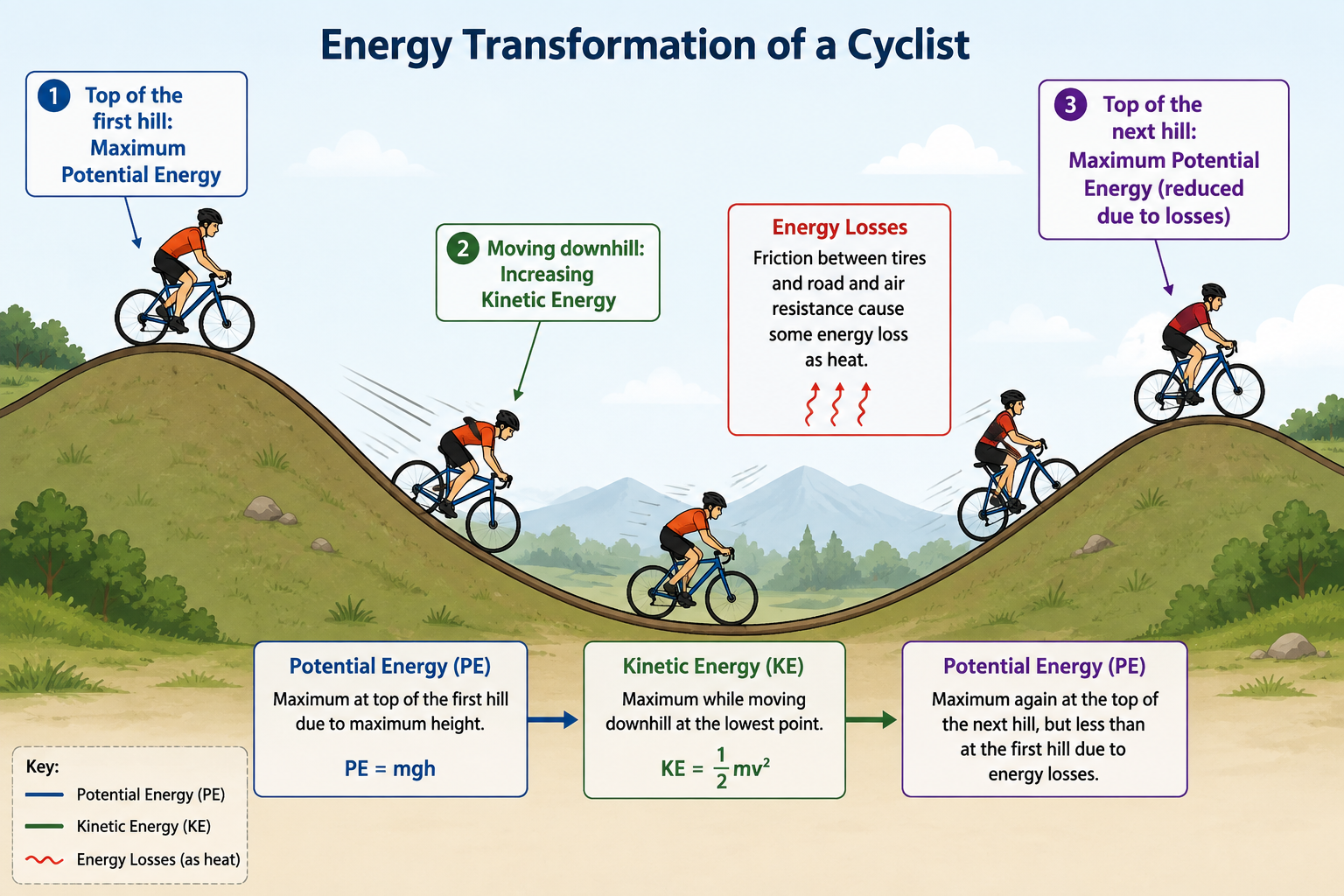
Renewable Sources of Energy
Yes, timber or wood is a renewable source of heat energy. It can be replenished through the growth of new trees, provided deforestation is managed sustainably. However, excessive use without replantation leads to resource depletion.
Energy Transformation
The ball's kinetic energy transfers to the glass, causing it to break. Some energy is lost as sound and heat.
Definition, Unit and Description of Kinetic Energy
Kinetic Energy:
The kinetic energy of a body is the energy that a body possesses by virtue of its motion.
Unit:
SI unit of kinetic energy is Joule (J).
Explanation:
To find out how much kinetic energy a moving body possesses, an opposite force can be applied on the body to stop its motion. Then the work done by the force will be equal to the kinetic energy of the body i.e,
Kinetic energy (Eₖ) = Work done (W)
Suppose a body of mass m is moving with velocity v. An opposing force F acting on the body through a distance S brings it to rest. Then,
Eₖ = Work done = F x S
As F = ma and S = Vₐᵥ x time
= (v + 0)/2 x t
= v/2 x t
Hence: Eₖ = ma x vt/2
= 1/2 ma x vt
Using velocity - time graph, the acceleration 'a' is given by its slope.
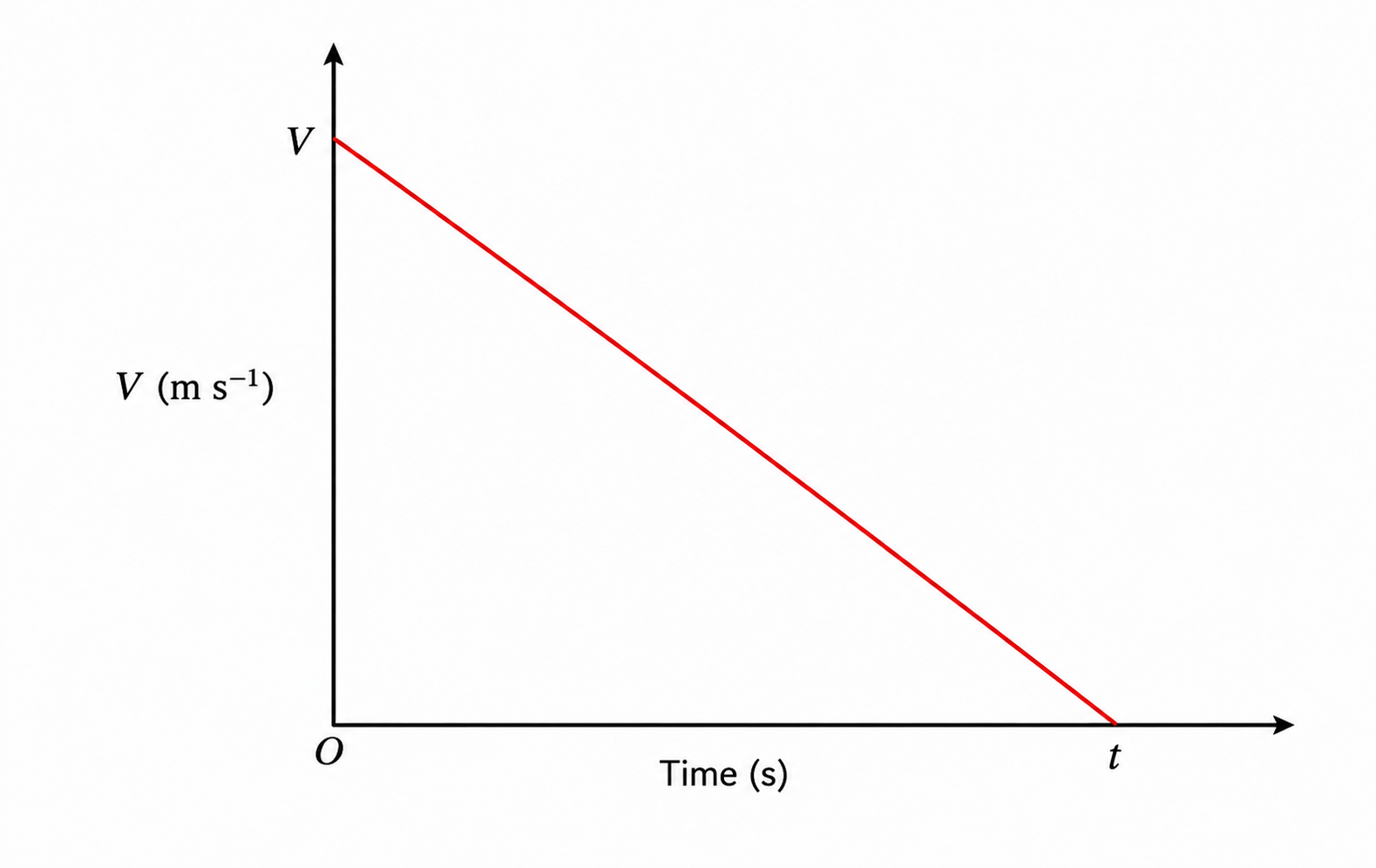
Hence, a = v/t , the slope is negative as the velocity and force are in opposite direction. Thus:
Eₖ = 1/2 m (v/t) x vt
or
Eₖ = 1/2 mv² ---- (5.3)
Law of Conservation of Energy with Example
Conservation of Energy:
Energy cannot be created or destroyed. It may be transformed from one form to another, but the total amount of energy never changes.
During energy transfer process, some energy seem to be lost and not accounted for in calculations. This loss of energy is due to work done against friction of the moving parts in the process. This energy appears as heat and is dissipated in environment. This energy does not remain available for doing some useful work and may be called waste energy.
A process of energy conversion and conservation can be described with the given example.
Let a body of mass m be at rest at a point A above the height h from the ground. Its total energy P.E is mgh.
Eₚ = mgh
and Eₖ = 0
Then the body is allowed to drop to point B at a height x from the ground. The body loses potential energy and gains kinetic energy as it get speed while falling down. Assuming air resistance negligible.
Eₚ = mg(h - x)
The loss of potential energy will appear as the gain in kinetic energy, hence at point B.
Eₖ = mgx
Total energy at B = E = mg(h - x) + mgx
= mgh
Just before hitting the ground at point C, the whole of potential energy is changed into kinetic energy. Thus
Eₚ = 0
and Eₖ = mgh
Thus the total energy remains the same as mgh. On hitting the ground this energy is dissipated as heat and sound in environment.
Difference Between Renewable and Non-Renewable Energy
Renewable Energy Sources:
Renewable energy sources are those that can be replaced by new one after their use, and they do not deplete over time.
Examples:
i. Hydroelectricity
ii. Solar energy
iii. Wind energy
Non-renewable Energy Sources:
Non-renewable energy sources are those that are depleted with continuous use and cannot be easily replaced. Once used up, they are gone for a long period of time.
Examples:
i. Fossil fuels
ii. Nuclear energy
iii. Natural gas
Efficiency of Machine
Efficiency:
The ratio of useful output energy and the total input energy is called the efficiency of working system.
or
Useful output energy
Efficiency = ------------------------
Total input energy
Efficiency is often multiplied by 100 to give percentage efficiency. Thus:
Useful output energy
Percentage Efficiency = -------------------------- x 100
Total input energy
During any conversion of energy, some energy is wasted in the form of heat. No device has yet been invented that may convert all the input energy into required output. That is why a system can not have an efficiency of 100%.
Electricity Generation - Hydroelectric and Fossil Fuels
i) Hydroelectric power generation:
Hydroelectric power generation is the process of producing electricity by using the energy of flowing or falling water. It typically involves a dam built on a river to store water in reservoir. When released, the water flows through turbines, spinning them to generate mechanical energy, which is then converted into electricity by a generator.
Advantages:
- Renewable and eco-friendly
- Low operating costs
- Provides flood control and irrigation.
Disadvantages:
- High initial cost
- Can disrupt aquatic ecosystems
- Affected by droughts
ii) Fossil fuels:
Fossil fuels are natural energy sources formed from the remains of ancient plants and animals over millions of years. The three main types are coal, oil (petroleum), and natural gas. They are burned to produce energy for electricity, transportation, and industrial processes.
Advantages:
- High energy output
- Reliable and widely available
- Supports many industries
Disadvantages:
- Causes pollution and greenhouse gas emissions
- Non renewable and depleting
- Leads to environmental damage (oil spills, mining)
Numerical # 1
Given data:
Force = F = 20N
Distance = d = 3m
θ = 60°
To Find:
Work done (W) = ?
Solution:
Work done is calculated using the formula,
W = Fd cosθ
= 20 x 3 x cos60°
= 20 x 3 x 0.5
W = 30J.
Numerical # 2
Given data:
Distance = d = 5m
Force = F = 8N
Work done = W = 20J
Distance = d = 5m
To Find:
Angle = θ = ?
Solution:
Using the work formula
W = Fd cosθ
⇒ cosθ = W / Fd
cosθ = 20 / (8 x 5)
cosθ = 20 / 40
cosθ = 1/2
θ = cos⁻¹(1/2)
θ = 60°
Numerical # 3
Given data:
Mass = m = 100kg
height = h = 80m
time = t = 25s
g = 9.8m/s²
To Find:
Power (P) = ?
Work done is given by:
W = mgh
W = 100 x 9.8 x 80
W = 78400J
Power = W / t
Power = 78400 / 25
P = 3200W
Numerical # 4
Given data:
Mass (m) = 20kg
Force = F = 40N
time = t = 5s
To Find:
Kinetic energy = ?
Solution:
Using Newton's Second law:
F = ma
⇒ a = F / m
a = 40 / 20
a = 2 m/s²
Vi = 0
Vf = Vi + at
Vf = ( 0 + 2 x 5)
V = 10 m/s
Kinetic energy = 1/2 mv²
Kinetic energy = 1/2 x 20 x (10)²
Kinetic energy = 10 x 100
K.E = 1000 J
Numerical # 5
Given data:
m = 160g = 0.16kg
h = 20m
g = 9.8m/s²
To Find:
Potential Energy (P.E) = ?
Solution:
P.E = mgh
= 0.16 x 9.8 x 20
P.E or Ep = 32J
Numerical # 6
Given data:
Mass (m) = 0.14kg
Initial velocity = Vi = 35m/s
Final velocity = Vf = 0 (at max height)
g = 9.8m/s²
To Find:
Maximum height (h) = ?
Solution:
Using the equation of motion
(Vf)² = (Vi)² - 2gh
0 = (35)² - 2(9.8)h
19.6h = 1225
h = 1225 / 19.6
h = 61.25m
Numerical # 7
Given data:
lowest point height = Minimum height = h = 1.2m
Highest point height = Maximum height = H = 2.0m
g = 9.8m/s²
To Find:
Maximum velocity and where it occurs = V = ?
Solution:
Using the energy conservation principle:
Using the energy conservation principle:
K.E max = P.E max
1/2 mv² = mg(H - h)
1/2 v² = g(H - h)
1/2 v² = 9.8(2.0 - 1.2)
1/2 v² = 7.84
v² = 15.68
√v² = √15.68
V = 4m/s
4m/s at the lowest position.
Numerical # 8
Given data:
Force = F = 50N
Angle = θ = 45°
distance = d = 20m
To Find:
Work done (W) = ?
Solution:
Work done is given by:
W = Fd cosθ
W = 50 x 20 x cos45°
W = 1000 x cos45°
W = 707J
Numerical # 9
Given data:
mass (m) = 5kg
d = 10m
θ = 30°
g = 9.8m/s²
To Find:
Work done = W = ?
Solution:
(i) Work done in pushing the box up the inclined plane.
W = mgd sinθ
W = 5 x 9.8 x 10 x sin30°
W = 250J
(ii) Lifting the box vertically up from the ground on the top of the inclined plane.
Given data:
m = 5kg
h = 5m
g = 9.8m/s²
To Find:
Work done (W) = ?
Solution:
Work done in lifting the box vertically:
W = mgh
W = 5 x 9.8 x 5
W = 250J
Numerical # 10
Given data:
m = 10kg
F = 80N
d = 15m
h = 5m
g = 9.8m/s²
To Find:
Efficiency = ?
Solution:
Work input:
Win = F x d = 80 x 15 = 1200J
Work output:
Wout = mgh = 10 x 9.8 x 5 = 490J
Efficiency = (Wout / Win) x 100
Efficiency = (490 / 1200) x 100
Efficiency = 41.7%
Numerical # 11
Given data:
F = 600N
d = 5m
t = 15sec
To Find:
Power (P) = ?
Solution:
W = F x d
W = 600 x 5
W = 3000J
P = W / t
P = 3000 / 15
P = 200W
Numerical # 12
Given data:
m = 40kg
h = 10m
t = 8sec
To Find:
Power (P) = ?
Solution:
W = mgh
W = 40 x 9.8 x 10
W = 3920J
P =W/t
P = 3920 / 8
P = 490W ≈ 500W
Numerical # 13
Given data:
Force F acts through distance L
Force increases to 2F to 2L
To Find:
Total Work done (W) = ?
Solution:
Work done in first part:
W1 = F x L = FL
Work done in second part:
W2 = 2F x 2L = 4FL
W = W1 + W2
W = FL + 4FL
W = 5FL